I’ve left Mainz behind, tied up all my loose ends, gave chocolate to my advisors, cookies for the doorman, pralines for the cleaning lady. Despite my best efforts I had a ton of stuff: one fifty or sixty-pound backpack, three smaller bags. And I opted to walk to the train station.
Bought my ticket: two hours to Karlsruhe, change of trains, an hour to Offenburg, change of trains, finally in Freiburg. My friend A. picked me up at the station, which was a godsend—three smaller bags were too much for me. I was traveling with the “happy weekend” ticket, good for local trains across Germany, inclusive S-Bahn. So in Freiburg we get into the S-Bahn; somewhere in the old town the conductor checks our tickets.
And he says mine isn’t valid.
He takes my driver’s license and tells me to get off the train. A. and I get off and follow him. He proceeds to explain to me that my ticket—which explicitly says ‘valid in S-Bahn’—is, in fact, not valid, because this is a private train company. Apparently the S-Bahnen from Berlin and Braunschweig, for instance, are included in the ticket, but others are not. How the @$%# was I supposed to know that my ticket should actually have read ‘valid in S-Bahn, except in some cities, but we won’t tell you which ones.’
The fine for riding without a ticket is 40 euros.
He says he doesn’t care that I didn’t know, he says (as per the placards on the train) that upon boarding the train I was bound by the service policies of the train company. I don’t dispute that. True, it was my fault I didn’t know, ignorance is no excuse—but it’s an honest mistake! I fork over my 50 euro bill. I’m close to tears. There isn’t much I can do. If I’d known, of course I’d have bought a ticket. He puts the bill in his pocket, continues with his lecture. I’m pretty distraught. I have a 50 pound backpack. I’m fresh off of the train from the state to the north.
He gives me the 50 euros back, because, as he said, I admitted I made a mistake and didn’t make a scene. I, of course, am completely grateful—though some part of me really wonders if he was on the level or just looking to give me a hard time. But I’ll never know, and I am now not 40 euros poorer, so I guess it’s all good.
I, of course, am now late for my appointment with my landlady, who is to give me the keys and explain stuff. She gives me the phone numbers of my other roommates and takes off.
My room is in the corner of the apartment, overlooking the street and a café/bar. We have quasi the top floor apartment (all floors have two apartments on each, except for the very top top, which has only one apartment. We live in the last floor to have two full apartments.
It’s a big apartment. Because we live on the top we have huge ceilings, in some places vaulted, and in most places 12 to 14 feet. My room is 18 m2 with partially slanted ceilings. The room next to me is listed, on the floorplan, as a closet and is 9 m2. The woman who lives there is only sometimes in Freiburg. There are then two further bedrooms, 22 m2 each, and an entryway hall bigger than most student bedrooms and a kitchen just as big, with a little balcony out onto the inner courtyard. The bathroom and the toilet are two separate rooms, which actually makes a lot of sense and cuts down on the morning traffic jam considerably, as we all share these two rooms. There is no living room (and isn’t one in most apartments). But it’s big, spacious, and airy. Most rooms have plank wood floors which creak, and it’s on the 4th floor of a restored villa/townhome on a quiet street near the S-Bahn station, five minutes into the city, eight to the University.
My room, however, has only a bed, mattress, and a desk chair in it. Everything else is up to me. But I looked through an IKEA catalogue (for anyone who has seen Fight Club, that is the catalog from which Jack is ordering his drapes or whatever in the very beginning), and found acceptable items for reasonable prices. IKEA is a Swedish company that sells build-it-yourself and out-of-the-box furniture with Scandinavian functionality and style, and a relatively long life considering they are relatively cheap. High quality particleboard, I guess. Most German teenagers have bedrooms from IKEA. Those familiar with the catalogue or products get déjà vu every time they enter your average German house.
I can probably buy a dresser, carpet, desk, bookshelf, sheets, and wardrobe for about 200 euros new. I think I am going to start by keeping my clothes on a bookshelf (I have almost nothing to hang and extremely few articles of clothing anyways). I’d really like a sofa. A TV will have to be bought used if at all—I’d be fine not having one at all, but since I can’t even watch DVDs on my laptop I have no way to watch anything. No rush. I’d like to get my clothes off the floor, but otherwise I don’t have to buy everything right away, and I need to find someone with a car before I buy a wardrobe.
A. and I just dumped my stuff at home and headed back into town to meet a friend of hers for coffee and cake. The cake slices were the size of pizza slices. I didn’t even order one (stomache upset from pretzels and apples on the train). They served hot chocolate and café au lait in bowls, not cups. We (A., M., and myself) decided to meet at A.’s place later in the week for dinner and to go to a particular bar on Friday.
Instead of going back to my empty room I headed to A.’s, where we cooked and ate dinner, watched a movie, drank some (mediocre) wine, and chatted. She lives in a district that is part of the city but fifteen minutes away by S-Bahm, separated by a greenbelt. Getting out of the S-Bahn we ran into an elderly couple. After initial attempts to communicate we established that they were French. They wanted to go to the bus stop that would take them to the gondola. I forgot the word for ‘straight ahead’ but managed to explain to them in French where they were supposed to go.
A.’s place is on the top of a hill, ten minutes from the S-Bahn station. She’ll keep in shape living up there. She lives in a newly built basement 2-room apartment, 20 m2, pays 2/3 what I do, gets along with her roommate. Just finished buying her bedroom furniture (IKEA) and her DVD player is temperamental. But we found a Luc Besson film to watch and had a great time. As we were at my flat she said she’d happily trade with me—where she lives is absolutely beautiful, in a verdant green valley full of old churches and gingerbread houses, but it’s a bit out of the way, and I’m happy I’m living near the city this time. Otherwise, though, the place is gorgeous, everything is new and pretty and very comfortable, with a garden and a terrace and such.
German introduced us in Braunschweig, as we would both be studying in Freiburg. It turns out we have similar tastes in music and movies, sport, etc. We get along like old friends. She and I are journeying to IKEA on Tuesday to look at stuff for my room, and her roommate might have access to a car at some point.
It was nice to have a slow morning on Sunday—I got home from A’s at 1 AM again, slept till 7 the next morning, and had onion bread for breakfast. After a thorough comb-thru of the IKEA catalog I showered and went into town, but there wasn’t much to see so I spent the rest of the morning reading the FAZ (Frankfurter Allgemeine Zeitung, Germany’s version of Le Monde, only not so socialist), cooking stew, having tea, and not doing much. It was interesting reading the FAZ, perhaps Germany’s most highly regarded newspaper, what the NY times or Wall Street Journal, Financial Times, something like that would be in the US—its use of the German language is of noticeably higher quality than the books and magazines I normally read. I read it practically cover to cover.
But after hours of reading you have to get up and do something, so I headed for a walk. Direction: up. Anywhere that went uphill, in the hope of getting a good view or at least a workout. I got both, and a ruined cloister, a tower, and a tudor-style mini castle to boot. The joy of walking in Germany, much like in England, is that you can pretty much go anywhere not marked ‘private,’ closed off with a gate, or encircled by a fence. As land is so expensive, people don’t own forest—people who own land build stuff on it. The state or the city owns the forests, so anyone is welcome to go there. Ten minutes from my house and I am hiking in the woods, the beginnings of the black forest. The trees are only beginning to turn, though at one point I came across a brilliant yellow tree in the midst of a forest of pines. And to spare myself the S-Bahn ticket I walked into town (20 minutes walk) and back. There wasn’t much to see or do, but more people wandering around and the sun was shining, so it wasn’t quite as cold, and actually quite nice till my legs started to mutiny.
Thursday, October 19, 2006

Saturday, October 14, 2006
Closing Time
"Another turning point, a fork stuck in the road. Time grabs you by the wrist, directs you where to go: so make the best of the test and don't ask twice--I hope you have the time of your life..." (Green Day)
We're standing in our office, end of the day. My officemate/advisor gathers her things and comes to my desk to say goodbye. We've grown rather close these last six weeks; she can vent her frustrations about some of the particulars of our department, we talk about her wedding and my plans and our lives. We still address each other formally though it actually doesn't feel weird to do so. As she is about to say goodbye she stops for a second, then says, "I actually wanted to say this earlier but couldn't figure out a good way to do so--I wanted to say, if it's okay with you, that we can address one another informally." (It only sounds slightly less awkward in German). She had noticed my other advisor addressing me by first name, and wanted to make sure I didn't think she was completely uptight. I think the whole situation is funny, and I spent the whole time wondering when we would be on a first-name basis, since I already knew way more about her life than your average acquaintence would. Ah, social awkwardness.
Well, that was it for my internship. I didn't actually do anything useful today; I sat and played free cell and tried to find paid internships to Africa (a few possibilities!). One of my advisors, to whose house I was invited to dinner, came and gave me a journal signed by his entire department and a purdy pen. My other advisor, with whom I share an office, gave me an entire bag full of fruit from the market and homemade muffins/cupcakes. I gave them each chocolate and a bag of microwave popcorn (my last one, till I get ahold of my suitcase!). She's half American, so she'll know how to cook it.
The rest of the day was wandering around, turning in my ID, paying my €1.17 phone bill, my €2.20 coffee bill, saying goodbye, cleaning out my desk, and trying to eat my refrigerator empty.
Everyone I know in Mainz sent me a text message and wants to meet up tonight. I'm going to pass on the disco invitation but will meet other people for drinks even though the weather is encouraging me to stay home with the telly. But that's a pathetic existence, so I'm going out.
"He who would travel happily must travel light.
(Antoine de Saint-Exupery, 1900 - 1944)
I have lots of stuff. I complain every time I move. I move far too often. It's a lot of work. I now have a backpack and three small packs full of clothes and stuff. I am taking my beloved pot with, though the plates and stuff will have to stay. I have no idea how to get all of this to the train station tomorrow. And I change trains twice. I hope I don't fall over backwards--I'd be as helpless as a turtle...
"Travel is fatal to prejudice, bigotry, and narrow-mindedness." (Mark Twain)
I met my friend O., my friend from aupair days with whom I went to Austria last year, for coffee yesterday. If I had been on the ball I'd have contacted her sooner--now that I am not jus around the corner it will be harder to see her. She's going to be studying in Mainz this year, business, I think. She's getting married in March. Her boyfriend is a pretty nice guy--I met him in Berlin a few months ago--though only 22. I want to go to their wedding. Wow...friends of mine getting married. She even joked that it would be cheaper for her to have kids while still a student than after she's done studying. She told me that, for a Russian, she's already considered old, and most girls her age are married with family. She also has to pay tuition in Germany--her diploma from Russia is not recognized by employers, and is considered by German universities to be the equivalent of an Associate's (though it *should* be considered at least a Bachelor's), meaning she has more studying to do if she wants any kind of German degree, but the University is charging her tuition as it is considered a "second" course of study. The lovely catch-22 of a foreigner: her degree only hurts her without helping her, all of the downside and none of the upside of having completed a course of study. This is her seventh consecutive year of study and she is considered 'just beginning'. Once again, the Blue Passport benefits make themselves known…
So, tomorrow I'm off. No idea when I will see internet again...
Wednesday, October 11, 2006
Running away...
I like running. I used to hate it; back when I first started, it was the closest thing to torture I had ever experienced, because I just couldn't do it. I was happy if I could make it 10 minutes at a time without having to walk in between. I'm astounded I managed the discipline to do it regularly. Sometimes, when I thought I couldn't go any farther, I'd start counting steps. One...two...three...four... up to thirty. Then I'd start over. Again. And again, to keep the one Forbidden Thought from remaining stuck in my mind like a mouse in a bucket: "I can't do this anymore." Until I was home, I would count to thirty.
Anyways, I got better. After a year of running regularly I could make it about fifteen or twenty minutes out, short breather, and the same distance back. I was a cheapskate, bought crappy shoes, and gave myself leg cramps, inch-long blisters, and wierd foot disorders that only made the whole thing more complicated. But I stuck it through. I bought good shoes. I trained. And I trained. And I trained. Each time I got faster. I stuffed a 3-mile run and cool-down into a one-hour break (including changing and getting to class). I ran every morning before school. I still run just about every day, though no longer in the mornings, 'cause it's bloody dark.
So, there I am, running. Sneakers: check. MP3 player: check. Shades: check. I'm good to go. I dodge traffic, ducking between cars and busses at an immensely complicated light which wasn't functioning. Left down to the tower, turn around, past the bridge, up past the cathedral, almost to the other bridge, along the Rhine all the way.

Everyone and their goldfish and their goldfish's second cousin is out for a walk on nice days. Packs of mommies and babies, punk kids off to the skater park or to tempt fate on the bank, young couples not noticing that their public display of affection is both very public and very affectionate, elderly ladies, herds of Japanese tourists, covies of Nordic walkers looking like a tracksuited centipede (a hundred arms, legs and poles moving rhythmically), the homeless, the unwanted, musicians with guitars, kids with bottles of beer. You name it, it's there.
Where was I? Oh, yes, running. So, there I am, running. I'm pounding pavement, dodging retirees, headphones pounding mediocre texts to a mildly aggressive beat into my skull, inspiring me to run faster (if only to get away-- but from the boyband tunes the thing occasionally, randomly, throws out, it's not possible to run fast enough to escape).
Then I see him.
He's about as tall as my kneecap, curly brown hair, big brown eyes. The most adorable kid I have ever seen. Patiently, and with utmost concentration, closing in on a pigeon with a stick. As I zoom towards him I am fascinated. One step, the pigeon moves away. Another. He decides to charge and toddles off after the bird like an animated garden gnome who's been hitting the apple wine a bit too hard. The lazy bird doesn't take off, just skitters off towards another invisible bit of muck to pick at.

Take two: As I am more or less level with him, the kid tries again. I follow him with my eyes, waiting to see how it will all turn out. And just as he is about to finally poke the evasive avian with his chosen implement (what is the point of poking a pigeon with a stick anyways?), narrowly missing a very surprised dog and his rather bemused owner, I trip over my feet and fall flat on my face.
Anyways, I got better. After a year of running regularly I could make it about fifteen or twenty minutes out, short breather, and the same distance back. I was a cheapskate, bought crappy shoes, and gave myself leg cramps, inch-long blisters, and wierd foot disorders that only made the whole thing more complicated. But I stuck it through. I bought good shoes. I trained. And I trained. And I trained. Each time I got faster. I stuffed a 3-mile run and cool-down into a one-hour break (including changing and getting to class). I ran every morning before school. I still run just about every day, though no longer in the mornings, 'cause it's bloody dark.
So, there I am, running. Sneakers: check. MP3 player: check. Shades: check. I'm good to go. I dodge traffic, ducking between cars and busses at an immensely complicated light which wasn't functioning. Left down to the tower, turn around, past the bridge, up past the cathedral, almost to the other bridge, along the Rhine all the way.
Everyone and their goldfish and their goldfish's second cousin is out for a walk on nice days. Packs of mommies and babies, punk kids off to the skater park or to tempt fate on the bank, young couples not noticing that their public display of affection is both very public and very affectionate, elderly ladies, herds of Japanese tourists, covies of Nordic walkers looking like a tracksuited centipede (a hundred arms, legs and poles moving rhythmically), the homeless, the unwanted, musicians with guitars, kids with bottles of beer. You name it, it's there.
Where was I? Oh, yes, running. So, there I am, running. I'm pounding pavement, dodging retirees, headphones pounding mediocre texts to a mildly aggressive beat into my skull, inspiring me to run faster (if only to get away-- but from the boyband tunes the thing occasionally, randomly, throws out, it's not possible to run fast enough to escape).
Then I see him.
He's about as tall as my kneecap, curly brown hair, big brown eyes. The most adorable kid I have ever seen. Patiently, and with utmost concentration, closing in on a pigeon with a stick. As I zoom towards him I am fascinated. One step, the pigeon moves away. Another. He decides to charge and toddles off after the bird like an animated garden gnome who's been hitting the apple wine a bit too hard. The lazy bird doesn't take off, just skitters off towards another invisible bit of muck to pick at.
Take two: As I am more or less level with him, the kid tries again. I follow him with my eyes, waiting to see how it will all turn out. And just as he is about to finally poke the evasive avian with his chosen implement (what is the point of poking a pigeon with a stick anyways?), narrowly missing a very surprised dog and his rather bemused owner, I trip over my feet and fall flat on my face.
Monday, October 09, 2006
Auf Wiedersehen
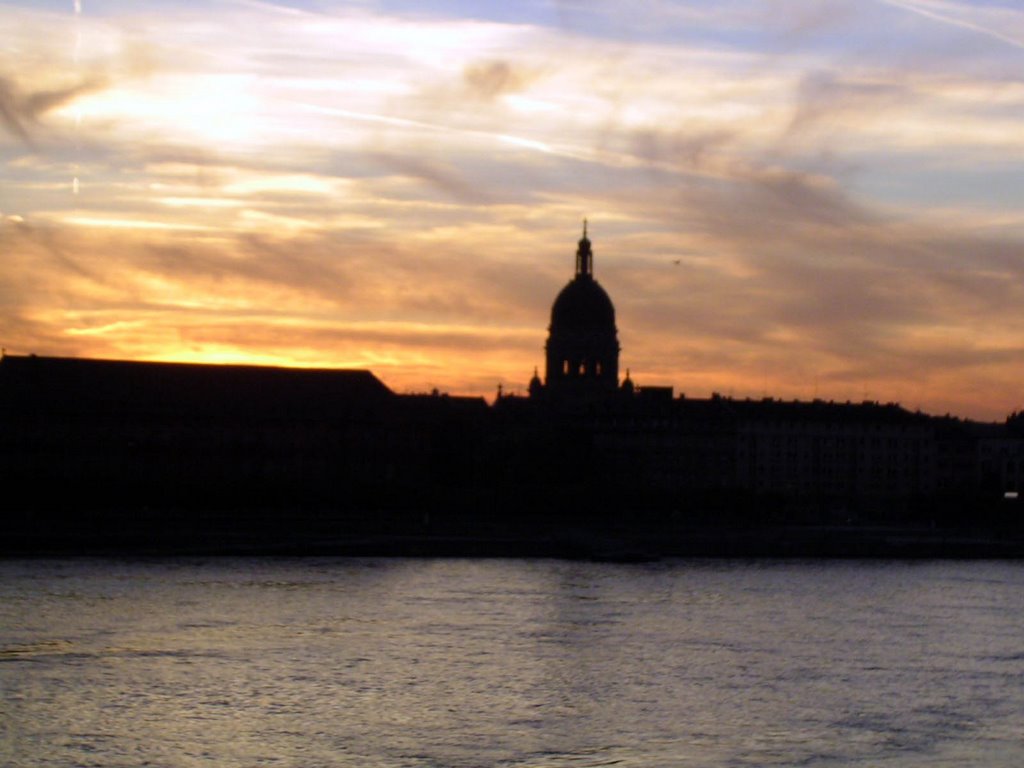
I've started my mourning for Mainz, where I finally realize I will have to leave, where I go about and each place, each experience is accompanied by the thought that it may be some time before I am there again. So it is at the market, in the shops, my favorite corners, the best bookstore, the best cafe.
I've decided my mood depends on the weather, and several days of rain gave me a somewhat black disposition. I slept poorly, I woke late or early but always tired. The black rings under my eyes were an adequate reflection of my general disposition. I recognize I'm in a bad mood when I don't want to do anything. I don't want to go out, can't stand staying in, can't focus on a book, don't want to watch TV, can't be bothered with solitaire and no number of cups of coffee bring me out of it.
These are the times I usually call my parents, and it usually makes me feel better. As I stood outside my friend's seemingly empty apartment, after waiting for twenty minutes, my laundry at my feet, I was about to do just that when the window opened and she motioned for me to come up, still chatting on the phone in italian.
Laundry took three hours, and that was not involving a dryer. But, between her phone calls we sat and chatted, and talking made me feel better, so my mood wasn't too terrible on Saturday.
Probably because Saturday was bright and sunny. I tried to avoid trampling elderly ladies at the flea market that had sprouted over my normal running path, on the river promenade, which had an astounding number of people for a Saturday morning. I spent the rest of the morning at the market, reading, browsing through stores for stuff I didn't need and wasn't going to buy, dodging the heavy and unexpected downpours that trapped me in a (usually boring) store for fifteen minutes at a time.
I eventually got dressed to go to dinner; I was invited to my advisor's house for a self-cooked dinner among friends and relatives. We cooked in a wok on the table, taking turns, and I was able to throw in a couple of vegetarian rounds amid the carniverous frenzy, accompanied by excellent wines and good conversation.
Aside:
I've lived in Germany a long time, for my perspective, and long enough to learn the language to the extent that I almost always recieve positive comments. I know how to conjugate the three forms of 'you.' Although I know the rules for their application, although they have been explained to me many times (start out addressing one another formally, as Herr or Frau whatever, and if the elder/higher ranked person offers the informal address, then you may be on informal terms) I *still don't get it*. Or rather, I get it, but it's not always clear.
Yes, I address my work colleagues formally, and it generally doesn't seem strange. Except on the company field trip I sat with a group of women, mid 20s to mid 30s, who immediately said, ''we address one another informally, among the not-so-old-people.'' Yet my advisor, a woman in her early 30s, still continues to address me as Frau B--and this doesn't seem strange to me, though our relationship is more personal than my relationship with most of my other colleagues (I know where she was born, grew up, about her family, her husband, her wedding, etc.). With other colleagues, though, it feels like it should still be an informal relationship yet we address one another formally.
So dinner parties are always an interesting situation for me: how do I address these people whom I have just met? I was in the position of addressing my other advisor (a gentleman in his 50s) formally, his wife (whom I had met minutes before) informally, same for the other guests. My advisor then suggested we address one another by first names but still formally. And as the evening wore on he slipped and addressed me informally, and we decided we would just leave it that way. At least I wasn't the one who screwed up, and he, as the elder, gets to make that decision. As an American, it's all the same to me, and I often feel the added distance of a formal address unnecessary among people who have been introduced--but also don't appreciate strangers talking to me as if they know me.
That sounds all long and complicated and boring, perhaps superfluous, but it's important to Germans and anyone who wants to be considered 'well brought up'. It causes me problems when I am unclear as to the situation--I have gone so far as to grammatically reconstructure all of my sentences to avoid the second person pronoun alltogether--no small feat. Try it sometime, I dare you (read: it should be tried, I challenge someone to do it).
I had a wonderful evening--that is an activity I immensely enjoy and a form of socializing with which I am comfortable. Biergärten, big parties, etc., really aren't my thing. I don't drink beer, don't like being drunk, and am usually the first one tired. I often check my watch waiting for it to be late enough that I can go home/to bed. Not that it's not fun, but it's not usually so wonderful that I don't notice it's 2 AM. This time, though, I didn't hardly notice that it was 11:30 until I looked at the clock in his car getting out. I'm eagerly anticipating whether or not we will be on formal or informal terms on monday.
So, that was Saturday. Sunday I fell out of bed, popped an aspirin for my light hangover (the wine was good but I had relatively little, and still got to feel it the next morning). Managed to eat my breakfast and forgot to brush my teeth as I headed for my train to Frankfurt. I'd been given a free ticket to the Frankfurter Buchmesse, the book convention. A million publishers in a huge gargantuan convention center, floors upon floors upon floors, organized by type, country, publisher, subject, you name it. The comics section was filled with mobs of not so youngsters dressed as anime characters. The film and TV section had costumes from some recent films and a screening room. If I had been there on Wednesday I could have watched 'The devil wears Prada' and 'Das Parfum,' a new movie by a well-known German director (Run Lola Run, among others). As it was I watched an excellent Indian movie, quite sad but also wonderfully funny, and was driven out into the city by the lack of affordable edible food at the convention center.
Turns out there is an 'Oldtimer' show goign on, with over two hundred vintage cars of various persuasions. Dad, I photographed all the Jaguars, just for you. An XK 120, a 150, a couple E-types, a Mark II, and various others. And I found the one and only Mustang, marine blue, for the steal price of 29,000€. Spare change, that.
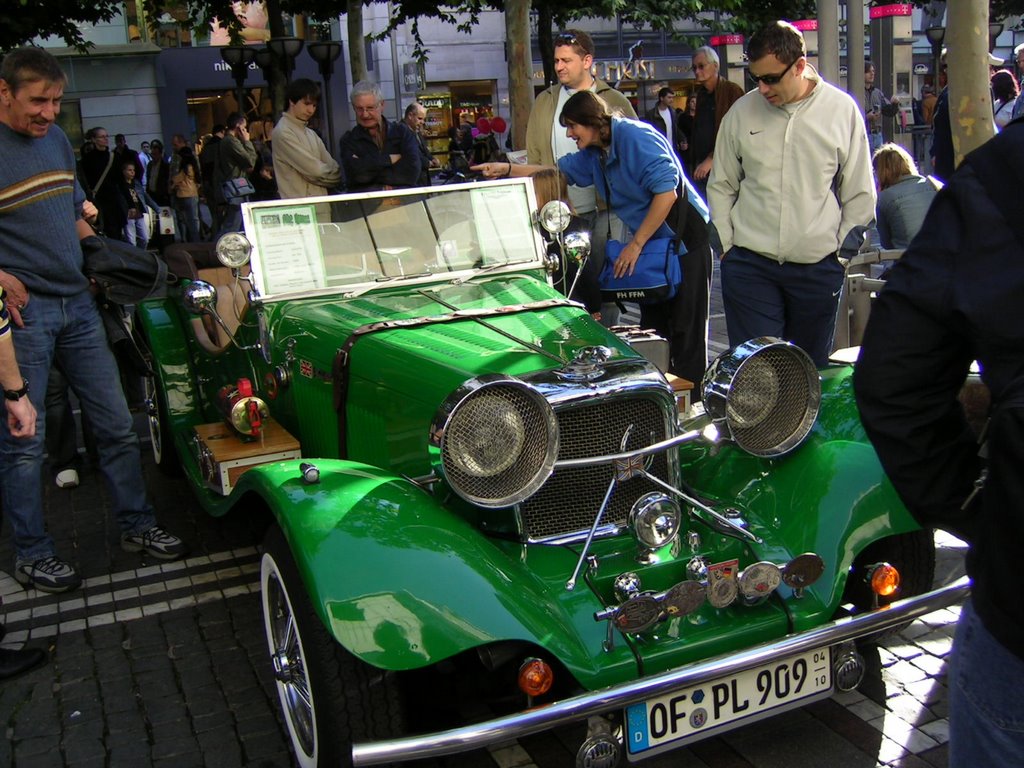
1936 Jaguar SS100
Strangely enough for a Sunday, most shops were open, the streets were full, the bratwurst sellers were in full swing, and you could buy apple wine or beer on every corner, with a live band to boot. I was supposed to meet a friend at an Oktoberfest in Mainz in the evening, but between staying late in Frankfurt, issues with the S-Bahn coming home (why am I ALWAYS going the wrong direction?), and the whole bridge-jumping thing, I rain checked for later in the week.
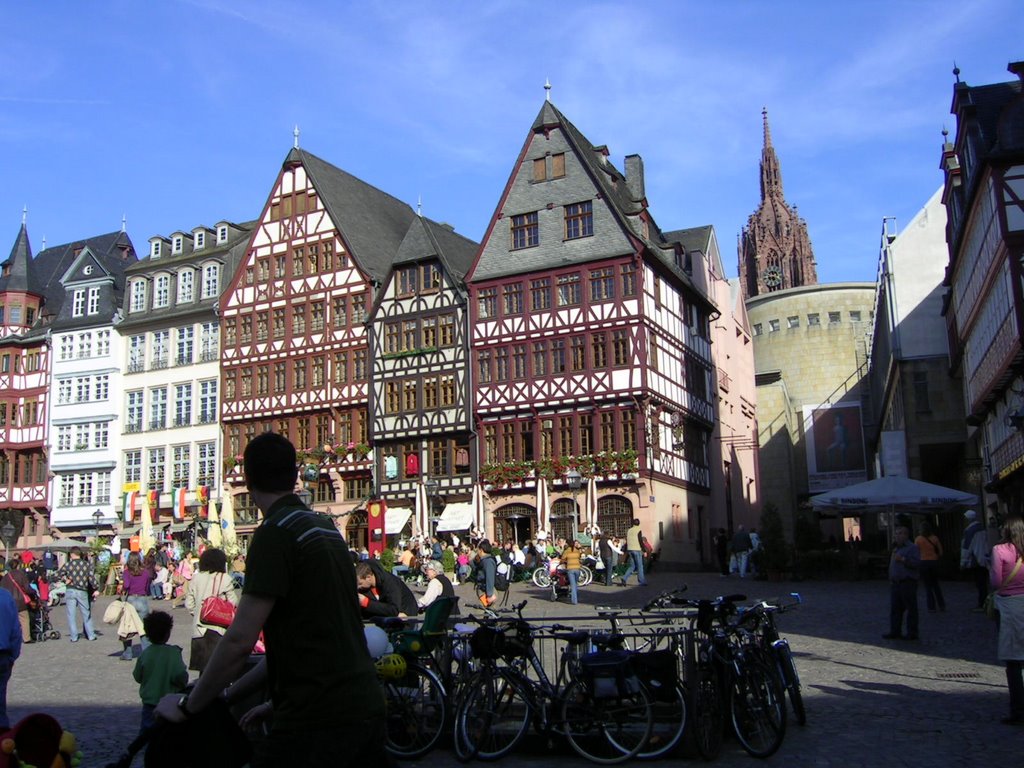
Frankfurt
The weather has been pretty cooperative--brilliant blue skies Saturday and Sunday mornings, fantastic sunsets both nights, and a full, orange moon hanging like a pumpkin over the horizon to boot. Ah, c'est la vie. C'est l'automme...
UPDATE--turns out we're on informal terms, after an initial bout of habitual formality.
Unexpected
It's a bad way to go.
Trooping home after a very long day, contemplating my upcoming dinner and the growing cramp in my leg, stopping to capture the last fleeting breath of daylight on what may likely be my last clear evening in Mainz. I stopped often on the bridge, marvelling at the clear air, the flocks of birds collecting on the lampposts above me, the magnificant sunset behind the pariament buildings, the palace, and the Kaiser's Church. I photographed. I lingered.
Two minutes is a long time.
As I was passing the halfway point I heard someone yelling, and looked to see someone in the water. In the river, swimming, yelling something incoherent. I asked a young bicyclist:
'What's with him?' I ask.
'He jumped off the bridge,' the guy replies calmly.
'He did what?!' I'm not getting it.
'He jumped off the brige. He wanted to commit suicide and asked me to push him in. I refused. He jumped on his own.' Still calm. I'm standing there, watching this man swimming. The goosebumps crawling slowly up my legs and arms like an ant colony do not make me realize the swimmer's danger, at dusk of a not so warm day. My companion on the bridge comes to the eventual conclusion that the guy deserves whatever he gets. I'm speechless. I continue walking. I still don't really get it.
911 is not 911 everywhere else. Honestly, I don't know the number here--I think it's 101, or 112. I should learn. I don't know the answer when another passerby, a girl, asks me. She goes on to ask others. She must have found the right number.
I stand on the bridge and watch. He's swimming, midstream, in a river several hundred yards wide. Out of the corner of my eye, out of the growing dusk, I see the blue lights slowly converging on the bridge, first the left bank, then the right bank, police and firemen lining up behind me like a string of glittering pearls. First the scene is the coast guard boat, closely followed by a helicopter. We wave frantically at the boat, trying to direct him to where we last saw the swimmer.
I don't see him anymore. Two minutes is a long time.
No, I don't remember what he was wearing. No, I only saw him swimming, and I didn't understand him. I'm not a particularly useful eyewitness.
He doesn't surface.
Into the growing dusk the boats patrol the river; meanwhile, the cavalry has arrived, and basically join me at the railing. Our collective eyes scan the surface, but neither our combined wishes nor our powers of observation yield results.
The bicyclist said he told the jumper it wasn't going to work, he wouldn't be able to commit suicide that way. And he survived the fall...only to succumb to cold and water. If he reconsidered, if he had second thoughts, he had awhile look inevitability in the face. If he changed his mind, well--some times, there's no going back. I hope he still wanted an end to it all as badly in the water as he did in the moment of his brief and tragic flight. What a helluva way to go.
Trooping home after a very long day, contemplating my upcoming dinner and the growing cramp in my leg, stopping to capture the last fleeting breath of daylight on what may likely be my last clear evening in Mainz. I stopped often on the bridge, marvelling at the clear air, the flocks of birds collecting on the lampposts above me, the magnificant sunset behind the pariament buildings, the palace, and the Kaiser's Church. I photographed. I lingered.
Two minutes is a long time.
As I was passing the halfway point I heard someone yelling, and looked to see someone in the water. In the river, swimming, yelling something incoherent. I asked a young bicyclist:
'What's with him?' I ask.
'He jumped off the bridge,' the guy replies calmly.
'He did what?!' I'm not getting it.
'He jumped off the brige. He wanted to commit suicide and asked me to push him in. I refused. He jumped on his own.' Still calm. I'm standing there, watching this man swimming. The goosebumps crawling slowly up my legs and arms like an ant colony do not make me realize the swimmer's danger, at dusk of a not so warm day. My companion on the bridge comes to the eventual conclusion that the guy deserves whatever he gets. I'm speechless. I continue walking. I still don't really get it.
911 is not 911 everywhere else. Honestly, I don't know the number here--I think it's 101, or 112. I should learn. I don't know the answer when another passerby, a girl, asks me. She goes on to ask others. She must have found the right number.
I stand on the bridge and watch. He's swimming, midstream, in a river several hundred yards wide. Out of the corner of my eye, out of the growing dusk, I see the blue lights slowly converging on the bridge, first the left bank, then the right bank, police and firemen lining up behind me like a string of glittering pearls. First the scene is the coast guard boat, closely followed by a helicopter. We wave frantically at the boat, trying to direct him to where we last saw the swimmer.
I don't see him anymore. Two minutes is a long time.
No, I don't remember what he was wearing. No, I only saw him swimming, and I didn't understand him. I'm not a particularly useful eyewitness.
He doesn't surface.
Into the growing dusk the boats patrol the river; meanwhile, the cavalry has arrived, and basically join me at the railing. Our collective eyes scan the surface, but neither our combined wishes nor our powers of observation yield results.
The bicyclist said he told the jumper it wasn't going to work, he wouldn't be able to commit suicide that way. And he survived the fall...only to succumb to cold and water. If he reconsidered, if he had second thoughts, he had awhile look inevitability in the face. If he changed his mind, well--some times, there's no going back. I hope he still wanted an end to it all as badly in the water as he did in the moment of his brief and tragic flight. What a helluva way to go.
Saturday, October 07, 2006
Thank you for smoking...
I don't want to be one of those people who always insist that it's ''better in America.'' I like cultural differences. If I wanted everything to be the same, I'd have stayed home, saved myself $1200 in airfare and wouldn't have gotten rained on quite as much. But there is one thing that is, in my humble opinio, better in the United States and I wish fervently that Europe would copy it.
'Do you mind if I smoke?' (at least they ask)
(What I think:) Yes, of course I mind. It gives me a headache, makes my clothes reek, and gives me cancer.
'No, of course not.' (It is, after all, *their* office)
What can I say? It's not my office, and I hopefully won't have to stay long. There is often a window, and it ends up being more or less tolerable. But it really bothers me when the individual with the cigar--even worse--wanders throughout the building with his lovely little air-befouler, contaminating everything. It's immediately apparent where this individual has been, in the elevators, in my office, in the hallway. It stinks. Everywhere.
Perhaps this is the highnosed American perspective, that Smoking Is Bad And Should Not Be Done, the I-don't-smoke-so-noone-else-should-either. Normally I'm a live-and-let-live type. Where religion, politics, personal beliefs and habits are concerned, I'm pretty much fine with whatever it is you do as long as I don't have to do it too. In English it's called secondhand smoke. In German it's called Mitrauchen, it's a verb, and it translates to 'smoking with'. You smoke, I smoke with you, whether I want to or not.
Many European countries have banned smoking in pubs, restaurants, public places, sometimes public buildings, occasional train stations, large portions of airports, and a varying combination of other places. I think this is good. Some firms in Germany have forbade smoking in the office. Complaint: smokers are discriminated against because they have to go to the basement or outside to smoke. They should have a right to tar up their lungs if they want to. Go right ahead, I say, but not where I'm forced to endure it.
This is perhaps a rant: enjoy it while you have the chance (I try to behave myself the rest of the time). If you want to smoke, be my guest. Do dope: whatever. Drink yourself senseless? Hey, it's your liver, your paycheck, and your hangover. Polite people ask first if they can smoke--and polite non-smokers don't refuse them. They offer me one too, they don't take it poorly when I decline. Many, particularly people my age, like it, and don't want to quit. If I had my way, no one would smoke. Since I can't have my way, and since those people who want to should be allowed to give themselves cancer if they so desire, forbidding it altogether would please me and not them and is probably not a viable solution, as much as I may wish it. But there should not be smoking in places where non-smokers are forced to 'smoke with', and definately not in offices and restaurants.
**UPDATE: I feel vindicated... http://news.bbc.co.uk/2/hi/europe/6032125.stm
'Do you mind if I smoke?' (at least they ask)
(What I think:) Yes, of course I mind. It gives me a headache, makes my clothes reek, and gives me cancer.
'No, of course not.' (It is, after all, *their* office)
What can I say? It's not my office, and I hopefully won't have to stay long. There is often a window, and it ends up being more or less tolerable. But it really bothers me when the individual with the cigar--even worse--wanders throughout the building with his lovely little air-befouler, contaminating everything. It's immediately apparent where this individual has been, in the elevators, in my office, in the hallway. It stinks. Everywhere.
Perhaps this is the highnosed American perspective, that Smoking Is Bad And Should Not Be Done, the I-don't-smoke-so-noone-else-should-either. Normally I'm a live-and-let-live type. Where religion, politics, personal beliefs and habits are concerned, I'm pretty much fine with whatever it is you do as long as I don't have to do it too. In English it's called secondhand smoke. In German it's called Mitrauchen, it's a verb, and it translates to 'smoking with'. You smoke, I smoke with you, whether I want to or not.
Many European countries have banned smoking in pubs, restaurants, public places, sometimes public buildings, occasional train stations, large portions of airports, and a varying combination of other places. I think this is good. Some firms in Germany have forbade smoking in the office. Complaint: smokers are discriminated against because they have to go to the basement or outside to smoke. They should have a right to tar up their lungs if they want to. Go right ahead, I say, but not where I'm forced to endure it.
This is perhaps a rant: enjoy it while you have the chance (I try to behave myself the rest of the time). If you want to smoke, be my guest. Do dope: whatever. Drink yourself senseless? Hey, it's your liver, your paycheck, and your hangover. Polite people ask first if they can smoke--and polite non-smokers don't refuse them. They offer me one too, they don't take it poorly when I decline. Many, particularly people my age, like it, and don't want to quit. If I had my way, no one would smoke. Since I can't have my way, and since those people who want to should be allowed to give themselves cancer if they so desire, forbidding it altogether would please me and not them and is probably not a viable solution, as much as I may wish it. But there should not be smoking in places where non-smokers are forced to 'smoke with', and definately not in offices and restaurants.
**UPDATE: I feel vindicated... http://news.bbc.co.uk/2/hi/europe/6032125.stm
Wednesday, October 04, 2006
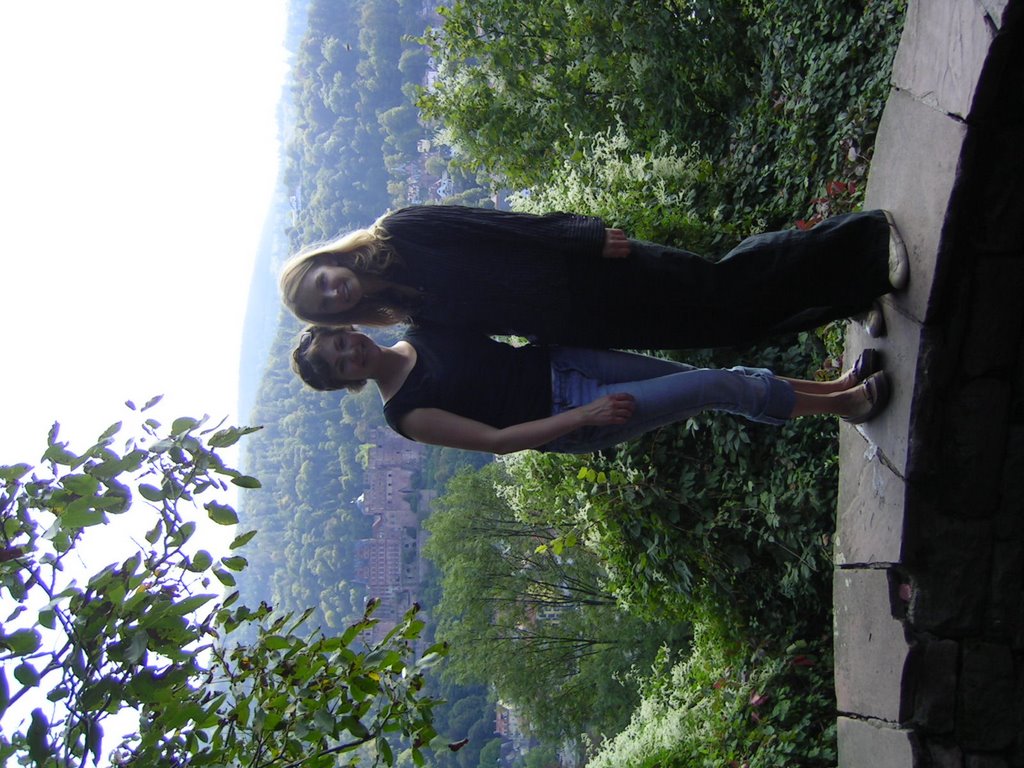
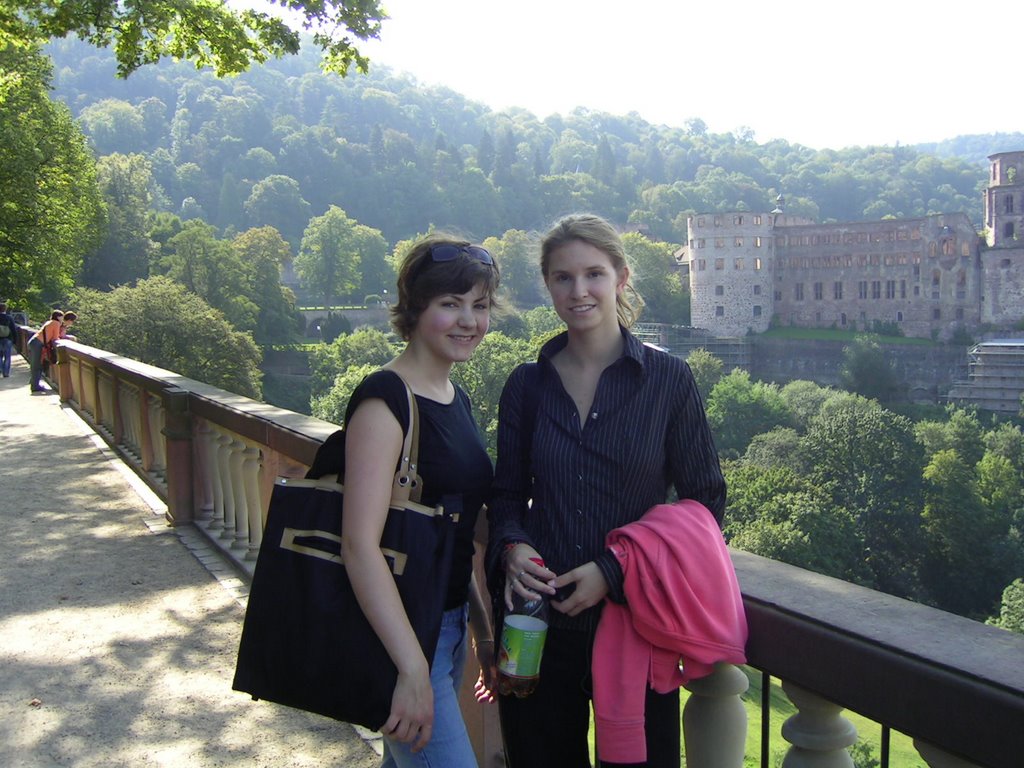
October thoughts
It’s October. I am now beginning my second consecutive and sixteenth total month in Germany. In my combined time I have had the opportunity to visit much of Germany and Europe as well. I love Germany and am glad I am here, and will definitely enjoy my remaining 10 months. I have learned the customs, I know how to read timetables, greet strangers, travel in strange towns, what to do at a dinner party, how to buy food at the market, how to tip at a café, how to behave in a formal situation. My German isn’t perfect; I still make mistakes, I probably always will, and though it is not obvious where I come from, it is noticeable that I come from somewhere else.
Looking back at my pictures from my first few months in Germany, two years ago: I photographed everything. I found the deciduous trees fascinating, I was astounded by Smart cars, impressed by cobblestone streets and red roofs, completely excited by street cafes and pedestrian zones, confused by windows and door locks, and completely flabbergasted by the plethora of ancient churches, castles, buildings, etc.
It’s all become so normal. These things no longer surprise, astound, or confuse me. I am no longer so excited when it rains, particularly in the summer. I no longer have the need to tour every church in town or visit every museum. I no longer stand on the porch with the key, unable to get in because I can’t figure out the lock.
But I miss being astounded by my surroundings. I miss struggling with the language (it’s been a very long time since I used a dictionary for anything other than translating formal documents), new experiences, different architecture, and other lifestyles: I need a challenge. I miss the new and different. I enjoy fiddle playing the most when the tempo is so fast I can barely hang on by the skin of my teeth, when I have to give my all to keep up. I enjoy riding the most when I have a squirrelly horse requiring my constant and undivided attention. I enjoy cities the most when they are new, where each street is a discovery and uncountable treasures await around every new corner.
It’s not that I don’t like routine. I like my days to go a certain way; I eat the same thing for breakfast every day, go running as often as the weather and my somewhat temperamental legs allow, show up for work/class at roughly the same time. I spend my free time in a limited number of ways. I love trying new things but I have a few favorite foods/restaurants/cafes/gelato flavors and also enjoy familiarity, knowing the outcome beforehand.
I like slowly getting to know a new place. First acquaintance is always new and full of mystery. Gradually exploring the streets and surroundings, meeting new people. Finding the right cafes and stores, learning the best baker, the best stand at the market for apples. Learning the language is like slowly cleaning a clouded window—the more you work, the clearer things get, until you are looking through the window. Some spots are still hard to see through, some things still remain hidden, but you can generally see through, and it begins to feel like home, and the language is no longer the shiny new pair of shoes (beautiful, exotic, not always comfortable) but rather the well-loved sweatshirt (warm, comfy, familiar).
I’m not one of Those Americans who travel abroad, who greet every new experience with, “but we do it This way,” or “everything is [insert superlative here: bigger, cheaper, faster, newer, shinier, easier] where I come from.” I don’t tend to evaluate cultural differences, I don’t get upset about things that are different and I don’t make a point of comparing. Lack of window screens here is not better or worse, it just is. I prefer some things in Germany to the United States, and vice versa. I like mineral water more than tap water but I also like free refills. I like having included tax and service at restaurants but appreciate also the more attention one becomes in the US. I like friendly strangers greeting me on the street but I like the fact that Germans don’t ask how you’re doing unless they really care, instead of ‘hihowsitgoin’. I don’t eat American bread on general principle and I don’t buy peanut butter in Germany. I appreciate the things I particularly enjoy about Germany when I am here, I don’t get upset about the things “lacking” or “different,” and I appreciate the American peculiarities when I am there.
I enjoy being the ‘foreigner,’ with its accompanying interest, and enjoy the praise for my hard-won language abilities (of course, I meet a ton of people who speak three or four languages as well as I speak my two, so my head doesn’t stay inflated for long). I don’t tell Europe stories too much in the US—it’s outside many people’s frame of reference, and they get more hung up on the place than the story—and I don’t get to speak German there, but the place really is a part of me and has determined many of my worldviews, so it’s not as if I want to leave the US and never come back.
All in all, Germany and America are my two homes: in both places I have friends and “family,” and I enjoy and look forward to it every time I go from one to another. But I want to live somewhere where I have to learn the language, and I want to experience what it’s like to be a member of a minority, to be visibly different from everyone else, an experience I don’t have in either Germany or the US. One day.
Looking back at my pictures from my first few months in Germany, two years ago: I photographed everything. I found the deciduous trees fascinating, I was astounded by Smart cars, impressed by cobblestone streets and red roofs, completely excited by street cafes and pedestrian zones, confused by windows and door locks, and completely flabbergasted by the plethora of ancient churches, castles, buildings, etc.
It’s all become so normal. These things no longer surprise, astound, or confuse me. I am no longer so excited when it rains, particularly in the summer. I no longer have the need to tour every church in town or visit every museum. I no longer stand on the porch with the key, unable to get in because I can’t figure out the lock.
But I miss being astounded by my surroundings. I miss struggling with the language (it’s been a very long time since I used a dictionary for anything other than translating formal documents), new experiences, different architecture, and other lifestyles: I need a challenge. I miss the new and different. I enjoy fiddle playing the most when the tempo is so fast I can barely hang on by the skin of my teeth, when I have to give my all to keep up. I enjoy riding the most when I have a squirrelly horse requiring my constant and undivided attention. I enjoy cities the most when they are new, where each street is a discovery and uncountable treasures await around every new corner.
It’s not that I don’t like routine. I like my days to go a certain way; I eat the same thing for breakfast every day, go running as often as the weather and my somewhat temperamental legs allow, show up for work/class at roughly the same time. I spend my free time in a limited number of ways. I love trying new things but I have a few favorite foods/restaurants/cafes/gelato flavors and also enjoy familiarity, knowing the outcome beforehand.
I like slowly getting to know a new place. First acquaintance is always new and full of mystery. Gradually exploring the streets and surroundings, meeting new people. Finding the right cafes and stores, learning the best baker, the best stand at the market for apples. Learning the language is like slowly cleaning a clouded window—the more you work, the clearer things get, until you are looking through the window. Some spots are still hard to see through, some things still remain hidden, but you can generally see through, and it begins to feel like home, and the language is no longer the shiny new pair of shoes (beautiful, exotic, not always comfortable) but rather the well-loved sweatshirt (warm, comfy, familiar).
I’m not one of Those Americans who travel abroad, who greet every new experience with, “but we do it This way,” or “everything is [insert superlative here: bigger, cheaper, faster, newer, shinier, easier] where I come from.” I don’t tend to evaluate cultural differences, I don’t get upset about things that are different and I don’t make a point of comparing. Lack of window screens here is not better or worse, it just is. I prefer some things in Germany to the United States, and vice versa. I like mineral water more than tap water but I also like free refills. I like having included tax and service at restaurants but appreciate also the more attention one becomes in the US. I like friendly strangers greeting me on the street but I like the fact that Germans don’t ask how you’re doing unless they really care, instead of ‘hihowsitgoin’. I don’t eat American bread on general principle and I don’t buy peanut butter in Germany. I appreciate the things I particularly enjoy about Germany when I am here, I don’t get upset about the things “lacking” or “different,” and I appreciate the American peculiarities when I am there.
I enjoy being the ‘foreigner,’ with its accompanying interest, and enjoy the praise for my hard-won language abilities (of course, I meet a ton of people who speak three or four languages as well as I speak my two, so my head doesn’t stay inflated for long). I don’t tell Europe stories too much in the US—it’s outside many people’s frame of reference, and they get more hung up on the place than the story—and I don’t get to speak German there, but the place really is a part of me and has determined many of my worldviews, so it’s not as if I want to leave the US and never come back.
All in all, Germany and America are my two homes: in both places I have friends and “family,” and I enjoy and look forward to it every time I go from one to another. But I want to live somewhere where I have to learn the language, and I want to experience what it’s like to be a member of a minority, to be visibly different from everyone else, an experience I don’t have in either Germany or the US. One day.
Monday, October 02, 2006
Why me?
I’m standing in a suit in the foyer, a folder clutched in my hands. I shift from foot to foot, checking the clock every minute or two. The Vice President comes. I’d met her at a few events previously; she is a popular keynote speaker at events sponsored by the Landtag. I follow her around, make a bit of small talk, check the clock, check the doors. The first few trickle in: two gentlemen of middle age, conversing in Hebrew. A few more arrive: some women, a couple, another two gentlemen. They introduce themselves, I bid them welcome. Some of them reply to my ‘’Wilkommen im Landtag’’ with an apologetic ‘’I’m sorry, I don’t speak German,’’ whereby I switch to English. It’s confusing; more people are arriving. Some speak German, some English, and among themselves they speak either Arabic or Hebrew. There are two translators present but it takes me a bit to figure out who they are.
The Vice President, Mrs. Klamm, begins her speech. She reads from the page; instead of the usual polite boredom masked with faux attention usually granted such a speach the foyer is filled with murmuring, the simultaneous translation into Hebrew and Arabic for those who do not understand German. Mrs. Klamm doesn’t pause for translation.
We adjourn to the club room for lunch. I count the guests, twice, three times. I don’t want to screw up. I tell the waitress how many we are and that I don’t eat meat, and we begin with rolls and salad. I am sitting next to the program organizer, across from one of the translators and two of the guests.
This event takes place every two years. A small group of Israeli and Palistinian authors come to Germany, discuss, have presentations, visit schools, visit the Landtag. And because of an odd twist of fate I am the only department member available to supervise—my advisor is at her wedding, her superior is on vacation in Florida, our department head has an appointment in Essen, and everyone else is either sick or doesn’t work Fridays.
Thus, I was left with this group of authors and the VP. They had a pre-ordered 3-course menu organized by my advisor (what do you feed these people without insulting any traditions?). The two authors across from me wave away their plates of chicken breast; the one says she didn’t like chicken, the other doesn’t say anything. We order a vegetarian plate for the woman, the man orders Fish, and then the woman wants fish as well and I run back to the kitchen.
The two with the fish take a long time to eat. Plates are cleared, dessert is served, and afterwards espresso, those two always half a course behind. The two with the fish are debating something, something about Jerusalem. The woman (Palistine) says Jerusalem is a part of her, and that she isn’t happy living in Ramallah. The translator throws out a cynical ‘’too religious for me,’’ before turning to me and saying, ‘’it’s all the same thing—who did what to whom. Endless counting, keeping score. It’s true, it’s a harsh past, but what they talk about is not the future.’’ What should I say? Better not to say anything.
We rush through our espresso and head for the plenary room, where Mrs. Klamm gives a short presentation. [The flag on the wall is from 1930. The crest from Rheinland Pfalz represents Pfalz, Trier, and Mainz. RLP is the first state to institute a round-robin style plenary chamber. Etc.] And of course, during our final round of picture taking from the terrace overlooking the river we lock ourselves out and have to call security to come let us in again.
In the end, I don't screw up and everything more or less goes as planned. I can't, however, say it is relaxing.
The Vice President, Mrs. Klamm, begins her speech. She reads from the page; instead of the usual polite boredom masked with faux attention usually granted such a speach the foyer is filled with murmuring, the simultaneous translation into Hebrew and Arabic for those who do not understand German. Mrs. Klamm doesn’t pause for translation.
We adjourn to the club room for lunch. I count the guests, twice, three times. I don’t want to screw up. I tell the waitress how many we are and that I don’t eat meat, and we begin with rolls and salad. I am sitting next to the program organizer, across from one of the translators and two of the guests.
This event takes place every two years. A small group of Israeli and Palistinian authors come to Germany, discuss, have presentations, visit schools, visit the Landtag. And because of an odd twist of fate I am the only department member available to supervise—my advisor is at her wedding, her superior is on vacation in Florida, our department head has an appointment in Essen, and everyone else is either sick or doesn’t work Fridays.
Thus, I was left with this group of authors and the VP. They had a pre-ordered 3-course menu organized by my advisor (what do you feed these people without insulting any traditions?). The two authors across from me wave away their plates of chicken breast; the one says she didn’t like chicken, the other doesn’t say anything. We order a vegetarian plate for the woman, the man orders Fish, and then the woman wants fish as well and I run back to the kitchen.
The two with the fish take a long time to eat. Plates are cleared, dessert is served, and afterwards espresso, those two always half a course behind. The two with the fish are debating something, something about Jerusalem. The woman (Palistine) says Jerusalem is a part of her, and that she isn’t happy living in Ramallah. The translator throws out a cynical ‘’too religious for me,’’ before turning to me and saying, ‘’it’s all the same thing—who did what to whom. Endless counting, keeping score. It’s true, it’s a harsh past, but what they talk about is not the future.’’ What should I say? Better not to say anything.
We rush through our espresso and head for the plenary room, where Mrs. Klamm gives a short presentation. [The flag on the wall is from 1930. The crest from Rheinland Pfalz represents Pfalz, Trier, and Mainz. RLP is the first state to institute a round-robin style plenary chamber. Etc.] And of course, during our final round of picture taking from the terrace overlooking the river we lock ourselves out and have to call security to come let us in again.
In the end, I don't screw up and everything more or less goes as planned. I can't, however, say it is relaxing.
Sunday, October 01, 2006
Oh ye last days of summer..
They've been threatening us with autumn for awhile now, holding poor weather and rain over our heads like a meterological sword of Damoclese. We, of course, have been desperately clinging to summer, avoided provoking the weather gods with open-toed shoes and lack of a jacket, and we have been well rewarded.
Needless to say, leaving the house at the crack of dawn for a jump on this Saturday's Great Adventure, unfurling our umbrellas and raincoats on our way to the train station, we considered giving in and staying home rather than spending the day in the rain. But a dose of optimism combined with an utter lack of stuff to do in Mainz spurred us on, and we went.
That's basically how we choose where we go. Linda wanted to give Luxembourg another shot, but it's four hours to the border, another hour from Trier to Luxembourg, and the whole trip would have amounted to a total of 10 hours in a train and €22 apiece. And Linda had to be back in Frankfurt by 9:00 PM, leaving us with approximately four hours there.
So: Köln (Cologne) or Heidelberg. We picked Heidelberg, as it would save us an hour each way. In the rain.
There's not many people out and about at 8 AM on a Saturday. We were therefore surprised to find the entire teenage population of Mainz, dressed in red sweaters and scarves, drinking beer at 8 AM on a Saturday. And of course, they all got on the same train as we did. We fought our way to a seat and became immediate and unintentional friends with our seatmates. Most everyone was on their second beer; many were smoking (in a non-smokign compartment--using the floor as an ashtray, I might add) but were otherwise quite nice people. They were off on a 4-hour Odyssey to Nürnberg to watch their football (read: soccer) team get creamed by Nürnberg's. I'm glad I'm not sharing the train with them on the way back.
Train change (finally!) in Darmstadt, south to Heidelberg. Arriving, we set off on foot for the Altstadt (being a tourist in Germany is easy: just head for the old city or anything marked Cathedral, Palace, Cloister, Castle, or otherwise marked ont he large helpful map out front. If you get lost, head for the tallest spire you can see, and you'll hit either the cathedral or the marketplace). The more we walked, the better the weather got, until it was brilliantly sunny with blue skies in all directions.
,,Heidelberger Herbst'', it was called (Heidelberg Autumn); a street fair complete with artisans, food stalls, ten to fifteen live music stages, and everyone within a 200-km radius, it seemed. We wandered, strolled, and schlenderten through the town, working our way to the base of the Castle Napoleon destroyed. The castle itself charges admission but the gardens are free, so we sat up on the wall and listened to ''Heart of Gold'' drifting up from somewhere below.

Linda's ex boyfriend was also in H. for the day with his ping pong team, and we met him for a few hours. It's obvious he still has feelings for L., it's obvious she doesn't, and it's obvious she's pretty uncomfortable around him. And then there I was, trying to keep the conversation going, not exclude anyone, watching Linda subtly assert her personal space, watching the Ex subtly find reasons to come nearer to her.

We went on the Philosopher's walk, where Goethe and his pals apparently went to drink absinthe. The town itself is built up two sides of the Necktar river valley, with the castle on one hill overlooking the old town, an old bridge connecting the two sides, and a smaller, hilly subdivision on the opposite side under the old cathedral ruins. Apparently has the oldest university in Germany. Or so they claim.
We were sad to leave, but had to rush back to Mainz so Linda could finish packing and head off to Frankfurt, where she would catch her return bus to Prague. I had intended to go to Frankfurt with her, but that would have required buying extra bus and train tickets for me, so I said my goodbyes at the bus stop. I sent her with a decent bottle of wine from the area, in memory of our time at the Weinfest and sitting on the banks of the river in the evenings. I plan to visit her, she hopes to come visit me.
Autumn has finally arrived; as I said my goodbyes and headed back inside the first drops began to fall, and I stood awhile at the window and watched the lightning.
Needless to say, leaving the house at the crack of dawn for a jump on this Saturday's Great Adventure, unfurling our umbrellas and raincoats on our way to the train station, we considered giving in and staying home rather than spending the day in the rain. But a dose of optimism combined with an utter lack of stuff to do in Mainz spurred us on, and we went.
''Get out the map, get out the map and lay your finger anywhere down. We'll leave the figuring to those we pass on our way out of town...''
That's basically how we choose where we go. Linda wanted to give Luxembourg another shot, but it's four hours to the border, another hour from Trier to Luxembourg, and the whole trip would have amounted to a total of 10 hours in a train and €22 apiece. And Linda had to be back in Frankfurt by 9:00 PM, leaving us with approximately four hours there.
So: Köln (Cologne) or Heidelberg. We picked Heidelberg, as it would save us an hour each way. In the rain.
There's not many people out and about at 8 AM on a Saturday. We were therefore surprised to find the entire teenage population of Mainz, dressed in red sweaters and scarves, drinking beer at 8 AM on a Saturday. And of course, they all got on the same train as we did. We fought our way to a seat and became immediate and unintentional friends with our seatmates. Most everyone was on their second beer; many were smoking (in a non-smokign compartment--using the floor as an ashtray, I might add) but were otherwise quite nice people. They were off on a 4-hour Odyssey to Nürnberg to watch their football (read: soccer) team get creamed by Nürnberg's. I'm glad I'm not sharing the train with them on the way back.
Train change (finally!) in Darmstadt, south to Heidelberg. Arriving, we set off on foot for the Altstadt (being a tourist in Germany is easy: just head for the old city or anything marked Cathedral, Palace, Cloister, Castle, or otherwise marked ont he large helpful map out front. If you get lost, head for the tallest spire you can see, and you'll hit either the cathedral or the marketplace). The more we walked, the better the weather got, until it was brilliantly sunny with blue skies in all directions.
,,Heidelberger Herbst'', it was called (Heidelberg Autumn); a street fair complete with artisans, food stalls, ten to fifteen live music stages, and everyone within a 200-km radius, it seemed. We wandered, strolled, and schlenderten through the town, working our way to the base of the Castle Napoleon destroyed. The castle itself charges admission but the gardens are free, so we sat up on the wall and listened to ''Heart of Gold'' drifting up from somewhere below.
View from the castle
Linda's ex boyfriend was also in H. for the day with his ping pong team, and we met him for a few hours. It's obvious he still has feelings for L., it's obvious she doesn't, and it's obvious she's pretty uncomfortable around him. And then there I was, trying to keep the conversation going, not exclude anyone, watching Linda subtly assert her personal space, watching the Ex subtly find reasons to come nearer to her.
We went on the Philosopher's walk, where Goethe and his pals apparently went to drink absinthe. The town itself is built up two sides of the Necktar river valley, with the castle on one hill overlooking the old town, an old bridge connecting the two sides, and a smaller, hilly subdivision on the opposite side under the old cathedral ruins. Apparently has the oldest university in Germany. Or so they claim.
We were sad to leave, but had to rush back to Mainz so Linda could finish packing and head off to Frankfurt, where she would catch her return bus to Prague. I had intended to go to Frankfurt with her, but that would have required buying extra bus and train tickets for me, so I said my goodbyes at the bus stop. I sent her with a decent bottle of wine from the area, in memory of our time at the Weinfest and sitting on the banks of the river in the evenings. I plan to visit her, she hopes to come visit me.
Autumn has finally arrived; as I said my goodbyes and headed back inside the first drops began to fall, and I stood awhile at the window and watched the lightning.
Thursday, September 28, 2006
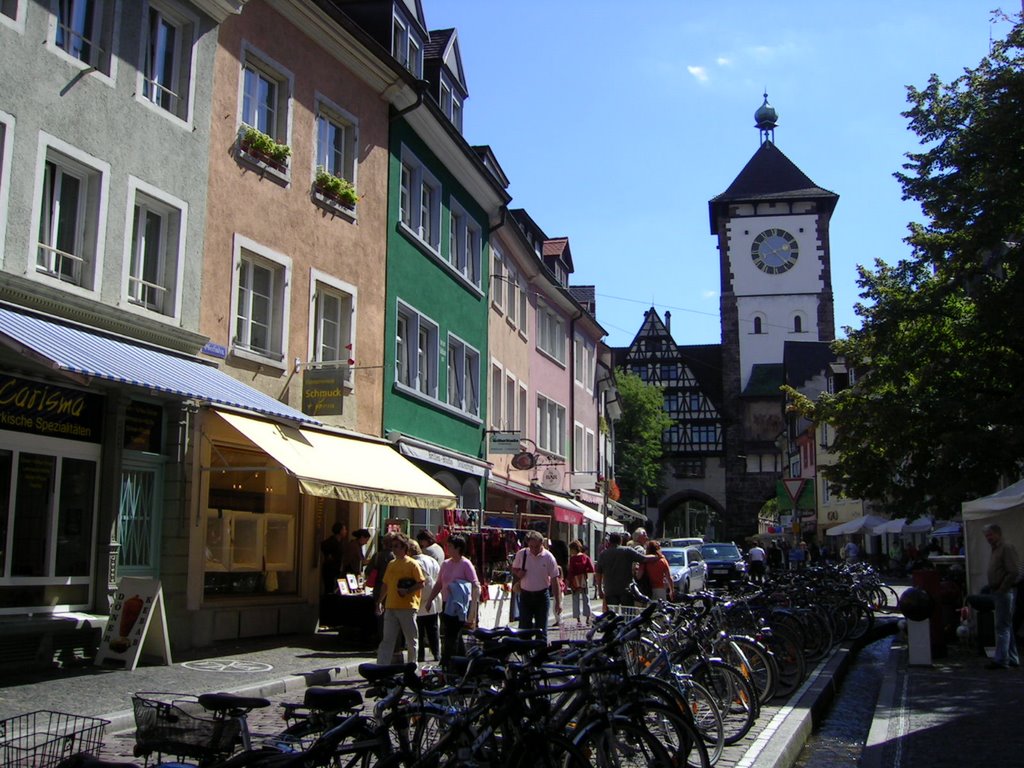

Back post #2
Another first weekend in Mainz post...
With a somewhat heavy heart I left Freiburg on the 9 o’clock train. When I was on my way from Braunschweig—where I was with friends and had been many times—to Freiburg I didn’t really want to go; I would have rather shown up in Mainz, where my accommodations were already arranged. Freiburg, in contrast, was to be a week of hectic searching, sleeping in the hostel, and general uncertainty. This was not an undue expectation and reality ended up being strikingly similar to my presupposition. Yet by the end of the week, the temperature increase matched by my spirits, a familiarity born of necessity and the stunning beauty of Freiburg endeared it to me. By schlepping myself all over the city looking at apartments I grew to know it, saw its better and worse parts, and knew how to get around, where the best gelato store and bakery were, from which stalls at the market to buy apples, and which way back to the hostel.
I wasn’t looking forward to going to Mainz. I’d have to leave Freiburg and go to a new city (again) where I knew not a soul (again).
At least I knew where I would be living. After only minor confusion I managed to find it, checked in with the doorman, and stumbled up to my new abode.
22 cubic meters isn’t much space. I would guess the bedroom to be 12 ft x 12 ft, with 8 ft x 12 ft divided into kitchen and bath.
It’s white.
Very white.
The carpet is gray and one of the doors is still veneer; otherwise, everything is white, depressingly cold, fresh with the smell of assemble-it-yourself furniture (of which all the built in cabinetry is built). No TV, no Internet. No microwave, dishes, silverware, pots, pans, containers of any sort, kitchen appliances of any manner, or much of anything besides a hotplate, refrigerator, and a sink. So I invested 3.50 euros in a knife, fork, spoon, and cup. I haven’t yet figured out how to heat water, but when I do I’ll be all set to drink tea. The joy of showing up on Saturday means that I had the opportunity to buy groceries (shops are often closed Sundays) without any kind of introduction.
My list of things to ask about:
- Washing clothes (unfortunately, my bag of dirty underwear to be washed at Sarah’s mistakenly got packed in the suitcase to be stored in Heiligenhafen until November. So not only do I get a nice surprise with my suitcase, I have very few underwear left)
- Trash. Who takes it out, and where does it go? Germans are particular about sorting trash, but not all cities are equipped to deal with compost.
- Cooking and eating utensils. Do they really expect me to eat out every day and/or buy it all myself? I don’t want to buy pots and pans!
- Bedclothes and towels. When, where, and how do I get new ones?
- Cleaning. There are no provisions for cleaning. I wouldn’t complain about having room service, but I also don’t mind doing it myself. But I am not buying my own #%$#$ vacuum cleaner, and it would be nice if I also didn’t have to buy dish rags and stuff.
- Internet. It’s the bloody parliament building. I’d be surprised if they didn’t have it. I do need something with which to entertain myself, seeing as my laptop does not play DVDs for some reason, and I only brought three with me anyways.
My list of stuff to buy:
- A plate, and probably a pot, assuming they don’t have some for me somewhere.
- Slippers. My feet are killing me.
- A sheet. Red, preferably, to drape over a bookshelf to put some color in the room. Likewise a tablecloth and placemat.
- Flowers. Or a vase. Or some other colored decoration, perhaps some pillows or something.
- New shoes. I have three pairs: black business pumps, running shoes (NOT to be worn in public here), and brown faux-leather flats that I have worn so much I have almost worn the sole through. I actually could use brown business shoes and a pair of casuals, but I don’t want to spend 50 euros on shoes.
So I sit in my little white room, listening to music, whiling away the hours. Honestly, I’m a bit bored. I had intended to go to a certain pub and watch some Fussball matches, Ireland v Andorra and England v Germany, but I couldn’t find the pub, and my feet were hurting so badly it was an effort to make it back to my building. So I finished reading my book, my second this week, organized my pictures, wrote a little, played solitaire…. As I lay in bed somewhat wistfully wishing I had something to be doing I heard laughing voices coming from somewhere outside. I looked to see if there was some kind of party going on below, but no, just some happy drunken people stumbling home. I opened the window and leaned out to get a better view, and it took me a few seconds to realize I was witnessing three men in a row urinating on the parliament building. Guess I wasn’t missing much after all.
Need suggestions for stuff to do in the evenings. The good ol standby, going to see a movie, is all well and good but is expensive. I have been spending less than 5 euros a day on food, so I have a hard time shelling out 7 euros a night for a film. I have no TV, no DVD player. I like hanging out in cafes and bars with friends but I don’t like sitting there alone, waiting for people to talk to me, small talking people I don’t (either on their initiative or mine). I don’t like getting to know people and I find first dates awkward. I like already knowing people. Discoing by myself, particularly as someone who doesn’t drink much, has only limited appeal. So what should I do?
My typical daily diet:
- Breakfast: roll with Harzerkaese (a particular type of cheese) or muesli with coffee, depending on how much of this I have to buy separately
- Snack: apple
- Lunch: another roll, some pickles, some apples or tomatoes, perhaps a salad
- Snack: cappuccino or gelato
- Dinner: another roll, some more harzerkaese, perhaps some tomato juice.
You may have noticed it consists primarily out of rolls, Harzerkaese, and apples. Every day for about a week now…
With a somewhat heavy heart I left Freiburg on the 9 o’clock train. When I was on my way from Braunschweig—where I was with friends and had been many times—to Freiburg I didn’t really want to go; I would have rather shown up in Mainz, where my accommodations were already arranged. Freiburg, in contrast, was to be a week of hectic searching, sleeping in the hostel, and general uncertainty. This was not an undue expectation and reality ended up being strikingly similar to my presupposition. Yet by the end of the week, the temperature increase matched by my spirits, a familiarity born of necessity and the stunning beauty of Freiburg endeared it to me. By schlepping myself all over the city looking at apartments I grew to know it, saw its better and worse parts, and knew how to get around, where the best gelato store and bakery were, from which stalls at the market to buy apples, and which way back to the hostel.
I wasn’t looking forward to going to Mainz. I’d have to leave Freiburg and go to a new city (again) where I knew not a soul (again).
At least I knew where I would be living. After only minor confusion I managed to find it, checked in with the doorman, and stumbled up to my new abode.
22 cubic meters isn’t much space. I would guess the bedroom to be 12 ft x 12 ft, with 8 ft x 12 ft divided into kitchen and bath.
It’s white.
Very white.
The carpet is gray and one of the doors is still veneer; otherwise, everything is white, depressingly cold, fresh with the smell of assemble-it-yourself furniture (of which all the built in cabinetry is built). No TV, no Internet. No microwave, dishes, silverware, pots, pans, containers of any sort, kitchen appliances of any manner, or much of anything besides a hotplate, refrigerator, and a sink. So I invested 3.50 euros in a knife, fork, spoon, and cup. I haven’t yet figured out how to heat water, but when I do I’ll be all set to drink tea. The joy of showing up on Saturday means that I had the opportunity to buy groceries (shops are often closed Sundays) without any kind of introduction.
My list of things to ask about:
- Washing clothes (unfortunately, my bag of dirty underwear to be washed at Sarah’s mistakenly got packed in the suitcase to be stored in Heiligenhafen until November. So not only do I get a nice surprise with my suitcase, I have very few underwear left)
- Trash. Who takes it out, and where does it go? Germans are particular about sorting trash, but not all cities are equipped to deal with compost.
- Cooking and eating utensils. Do they really expect me to eat out every day and/or buy it all myself? I don’t want to buy pots and pans!
- Bedclothes and towels. When, where, and how do I get new ones?
- Cleaning. There are no provisions for cleaning. I wouldn’t complain about having room service, but I also don’t mind doing it myself. But I am not buying my own #%$#$ vacuum cleaner, and it would be nice if I also didn’t have to buy dish rags and stuff.
- Internet. It’s the bloody parliament building. I’d be surprised if they didn’t have it. I do need something with which to entertain myself, seeing as my laptop does not play DVDs for some reason, and I only brought three with me anyways.
My list of stuff to buy:
- A plate, and probably a pot, assuming they don’t have some for me somewhere.
- Slippers. My feet are killing me.
- A sheet. Red, preferably, to drape over a bookshelf to put some color in the room. Likewise a tablecloth and placemat.
- Flowers. Or a vase. Or some other colored decoration, perhaps some pillows or something.
- New shoes. I have three pairs: black business pumps, running shoes (NOT to be worn in public here), and brown faux-leather flats that I have worn so much I have almost worn the sole through. I actually could use brown business shoes and a pair of casuals, but I don’t want to spend 50 euros on shoes.
So I sit in my little white room, listening to music, whiling away the hours. Honestly, I’m a bit bored. I had intended to go to a certain pub and watch some Fussball matches, Ireland v Andorra and England v Germany, but I couldn’t find the pub, and my feet were hurting so badly it was an effort to make it back to my building. So I finished reading my book, my second this week, organized my pictures, wrote a little, played solitaire…. As I lay in bed somewhat wistfully wishing I had something to be doing I heard laughing voices coming from somewhere outside. I looked to see if there was some kind of party going on below, but no, just some happy drunken people stumbling home. I opened the window and leaned out to get a better view, and it took me a few seconds to realize I was witnessing three men in a row urinating on the parliament building. Guess I wasn’t missing much after all.
Need suggestions for stuff to do in the evenings. The good ol standby, going to see a movie, is all well and good but is expensive. I have been spending less than 5 euros a day on food, so I have a hard time shelling out 7 euros a night for a film. I have no TV, no DVD player. I like hanging out in cafes and bars with friends but I don’t like sitting there alone, waiting for people to talk to me, small talking people I don’t (either on their initiative or mine). I don’t like getting to know people and I find first dates awkward. I like already knowing people. Discoing by myself, particularly as someone who doesn’t drink much, has only limited appeal. So what should I do?
My typical daily diet:
- Breakfast: roll with Harzerkaese (a particular type of cheese) or muesli with coffee, depending on how much of this I have to buy separately
- Snack: apple
- Lunch: another roll, some pickles, some apples or tomatoes, perhaps a salad
- Snack: cappuccino or gelato
- Dinner: another roll, some more harzerkaese, perhaps some tomato juice.
You may have noticed it consists primarily out of rolls, Harzerkaese, and apples. Every day for about a week now…
Back post...
''Living'', written on 3 September, as I was sick and locked in my cubicle of a bedroom in Mainz on my first weekend...
I find it interesting to consider my progression over the last several years. I remember a time when I thought I would never want to move away from home; I didn’t want to go off to college, and thought I would go to community college, live with my parents, ride my horse, and life would continue much as it had. This phase was succeeded by one where I would have given anything—including body parts and first born child—for the chance to go to Europe. I wasn’t allowed to be an exchange student; I was too young and the programs were expensive. I am not sure which of the two was more important, but in any case, I didn’t go, and I don’t criticize my parents for their decision. I probably could have handled being on my own at that age, but, as my mother said, it wasn’t a limited time offer, and I lost nothing in waiting a few more years, and gained perhaps quite a bit more.
Anyways, facing my senior year in high school, faced with senioritis leading me to cut many of my classes (yes, I cut classes. Yes, I still got As. Bad reinforcement?). I didn’t want to go to college; I had no idea what I wanted or why I would be there, and it was lots of money and just more school. And I still wanted to go to Europe.
So I went. I found myself a family on the internet, made an arrangement with them, and two weeks after my high school graduation left for Europe. I arrived in the company of our former exchange student, with whose family I spent the next few weeks. From the time of my arrival to the beginning of my aupairship I was either with friends or with my mother.
As I said goodbye to my mother and my friends and watched them drive away, leaving me in a small town on the Baltic with a family I had met only upon ringing their doorbell, for whom I would work for a year, it was the first time I had lived away from home. It would be some time before I saw my family again. I was on my own…
…but I was still with a family. I managed to pick a good one, or they picked me, but they helped me out, made sure I got my papers in order, was registered for whatever I needed to be, got where I was going, could decipher the train timetables, dropped me off and picked me up places, leant me their car, entrusted me with their kids and 100 euro bills. Basically adopted me.
I shared a bathroom with three girls, and a house with five other people. I was part of a family; we ate together, we did things together. In sight of this, it was a bit of a change for me to suddenly be living in a condo near the university, with two roommates whom I didn’t know. Not part of a family. I was so used to someone being there all the time with whom I could converse, with whom I could go for walks or who would interrupt me while reading, who would suggest movies or sit with me while I ate. I hardly saw my roommates, and when I did, we never progressed much beyond small talk. If I got bored, I called my mother to talk, or went for walks.
It took me awhile to get used to this level of being alone. Sometimes I was lonely. I had a hard time starting new friendships and the first several months saw me sitting at home a lot. The last several months I had friends, and conversely, it didn’t bother me so much when I was alone. I ejoyed it when my roommates weren’t there on weekends; I could turn on the radio at 5 AM if I wanted, without bothering anyone.
Once again, it was a bit of a lurch to be back with my respective German friends, to live with a family, then to live with a family with kids. I had to go for walks by myself because I was unused to the constant company.
As I was looking for apartments I thought I wanted a single, no roommates, just me. Then I could turn my radio on at 5 AM if I wanted to, I could have a dog, I could clean the kitchen or not. I looked at a single apartment, I looked at a boarding house that had the detractions of shared space (me and 13 others sharing two bathrooms and one kitchen) without the benefits (company of other people). They all looked so lonely. The apartment where I ended up holds four people, and I am looking forward to it. And on my search I made some new friends, whom I will hopefully keep. One step forward…
Some part of me would enjoy living alone. Other parts of me need the company. I am facing six weeks of a single apartment, the size of a hotel room, and no option to call my mother if I get bored.
I find it interesting to consider my progression over the last several years. I remember a time when I thought I would never want to move away from home; I didn’t want to go off to college, and thought I would go to community college, live with my parents, ride my horse, and life would continue much as it had. This phase was succeeded by one where I would have given anything—including body parts and first born child—for the chance to go to Europe. I wasn’t allowed to be an exchange student; I was too young and the programs were expensive. I am not sure which of the two was more important, but in any case, I didn’t go, and I don’t criticize my parents for their decision. I probably could have handled being on my own at that age, but, as my mother said, it wasn’t a limited time offer, and I lost nothing in waiting a few more years, and gained perhaps quite a bit more.
Anyways, facing my senior year in high school, faced with senioritis leading me to cut many of my classes (yes, I cut classes. Yes, I still got As. Bad reinforcement?). I didn’t want to go to college; I had no idea what I wanted or why I would be there, and it was lots of money and just more school. And I still wanted to go to Europe.
So I went. I found myself a family on the internet, made an arrangement with them, and two weeks after my high school graduation left for Europe. I arrived in the company of our former exchange student, with whose family I spent the next few weeks. From the time of my arrival to the beginning of my aupairship I was either with friends or with my mother.
As I said goodbye to my mother and my friends and watched them drive away, leaving me in a small town on the Baltic with a family I had met only upon ringing their doorbell, for whom I would work for a year, it was the first time I had lived away from home. It would be some time before I saw my family again. I was on my own…
…but I was still with a family. I managed to pick a good one, or they picked me, but they helped me out, made sure I got my papers in order, was registered for whatever I needed to be, got where I was going, could decipher the train timetables, dropped me off and picked me up places, leant me their car, entrusted me with their kids and 100 euro bills. Basically adopted me.
I shared a bathroom with three girls, and a house with five other people. I was part of a family; we ate together, we did things together. In sight of this, it was a bit of a change for me to suddenly be living in a condo near the university, with two roommates whom I didn’t know. Not part of a family. I was so used to someone being there all the time with whom I could converse, with whom I could go for walks or who would interrupt me while reading, who would suggest movies or sit with me while I ate. I hardly saw my roommates, and when I did, we never progressed much beyond small talk. If I got bored, I called my mother to talk, or went for walks.
It took me awhile to get used to this level of being alone. Sometimes I was lonely. I had a hard time starting new friendships and the first several months saw me sitting at home a lot. The last several months I had friends, and conversely, it didn’t bother me so much when I was alone. I ejoyed it when my roommates weren’t there on weekends; I could turn on the radio at 5 AM if I wanted, without bothering anyone.
Once again, it was a bit of a lurch to be back with my respective German friends, to live with a family, then to live with a family with kids. I had to go for walks by myself because I was unused to the constant company.
As I was looking for apartments I thought I wanted a single, no roommates, just me. Then I could turn my radio on at 5 AM if I wanted to, I could have a dog, I could clean the kitchen or not. I looked at a single apartment, I looked at a boarding house that had the detractions of shared space (me and 13 others sharing two bathrooms and one kitchen) without the benefits (company of other people). They all looked so lonely. The apartment where I ended up holds four people, and I am looking forward to it. And on my search I made some new friends, whom I will hopefully keep. One step forward…
Some part of me would enjoy living alone. Other parts of me need the company. I am facing six weeks of a single apartment, the size of a hotel room, and no option to call my mother if I get bored.
Wednesday, September 27, 2006
Photoness!
I have managed to smuggle some photos onto my work computer using a floppy disk (yes, they still exist--curses on not having a CD burner!). Poor resolution and all.
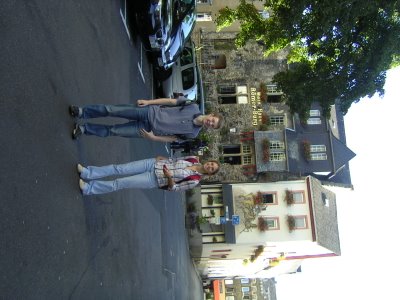

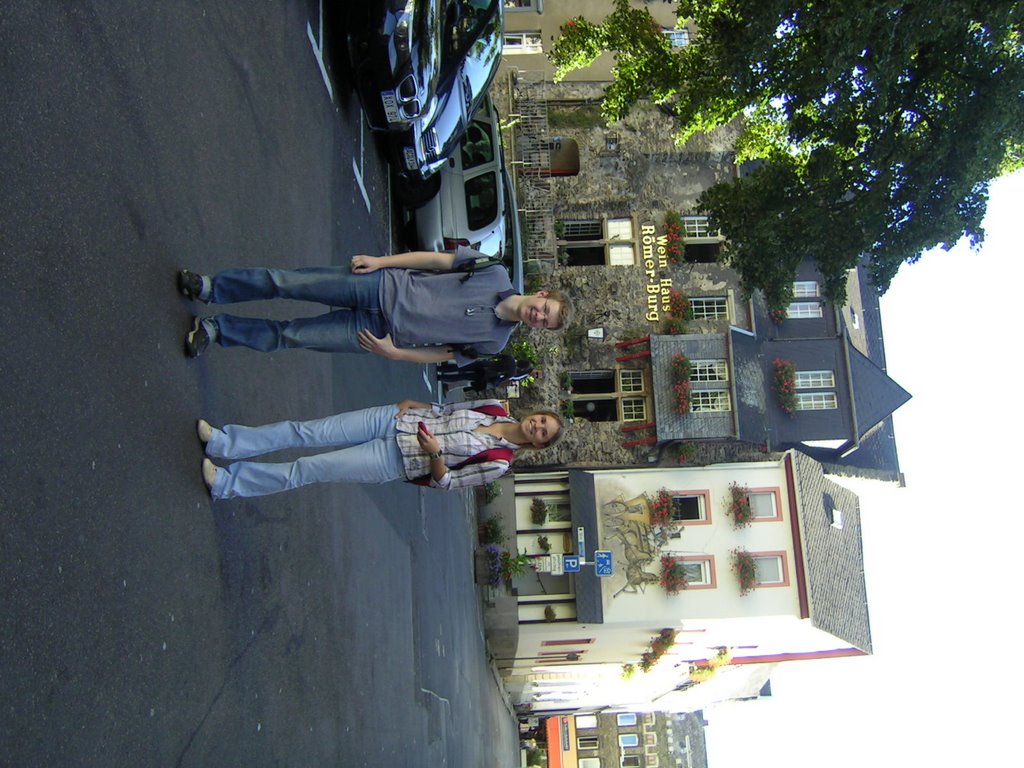
This is us in a town called Boppard, on the Rhein river, with Linda.

Me in Bamberg.
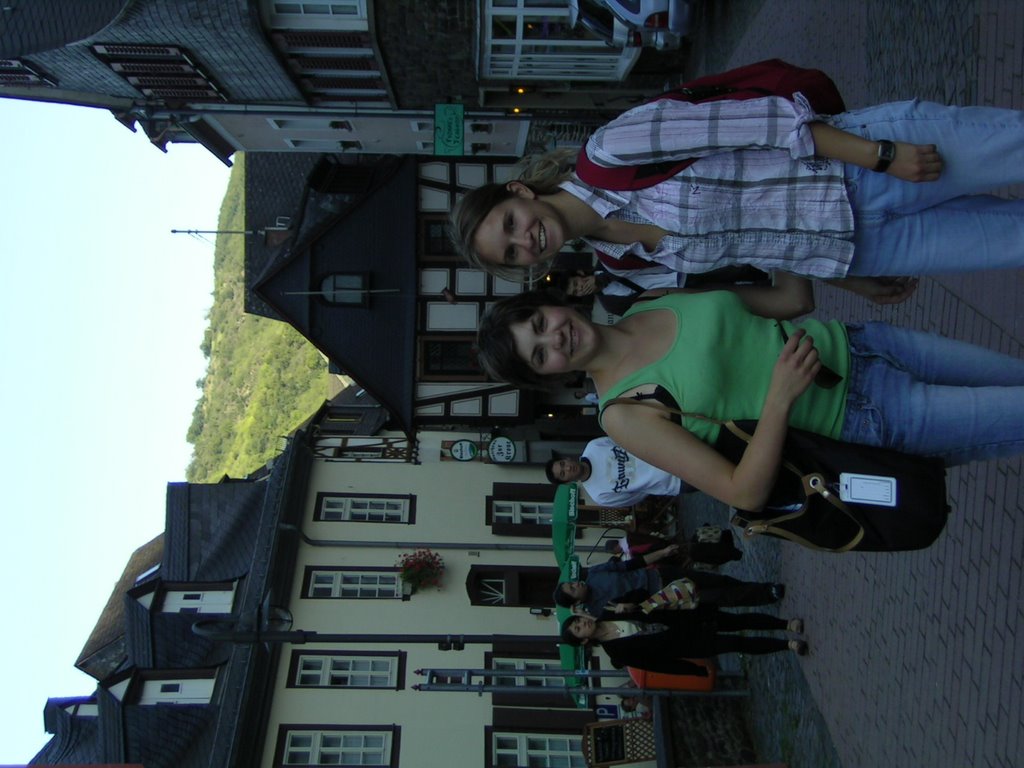
St. Goar, a town on the Rhein.
Our laundry party---me with the French kids.
Friday, September 22, 2006
Politics
Politics is the art of preventing people from taking part in affairs which properly concern them.
Paul Valery (1871 - 1945), Tel Quel 2 (1943)
It’s a wonder anyone understands democracy. It’s no wonder that most people don’t. Where laws come from, how the representatives do anything, the functions of different people, internal politics, external politics, party politics, and politics in general—it’s like speaking a foreign language. Policies (what a certain group thinks about a certain subject) are often confused with politics (the often mysterious reasons things happen the way they do). I don’t claim to understand what’s going on; I am beginning to realize how complicated it all is.
Theoretically simple: There’s a problem. Each group, usually a party, sits down and thinks about what it wants to do about this problem. They write this down, share this with everyone else, and whoever’s solution is most popular wins, and that’s the policy that’s implemented.
Add politics: There’s a problem. Each group, usually a party, sits down and thinks about what it wants to do about this problem. They write this down. They don’t necessarily share this. The group that is in charge either a) promotes its solution as the only and best, or b) pretends there is no problem. The other groups are busy either a) complaining about the group in charge without offering a solution of their own, or b) supporting a different policy by trying to win over the swing people. Sometimes, one group stabs the other in the back just because they can. Usually the opposition criticizes the ruling group just on general principle out of a basic and unwavering belief that whatever the other guy did has to be wrong.
The more you read and observe about this Politics thing, you got to admit that each party is worse than the other. The one that's out always looks the best.
Will Rogers (1879 - 1935), Illiterate Digest (1924), "Breaking into the Writing Game"
Why are there differing policies? Sometimes it stems from a basic difference of opinion: one party thinks the government should solve It (whatever It is) via programs, departments, ministries, funding, whatever; the other thinks that this is not the government’s job. Sometimes it stems from representation of interests: one party was elected by workers who like the government to solve its problems; the other party constituents would rather pay fewer taxes and take care of their own problems.
Sometimes there are principles. Sometimes there are politics: the party decides to support a solution because the people who care about this solution a) contribute money, b) contribute votes, or because the problem looks bad if it goes unsolved.
Politics, n. Strife of interests masquerading as a contest of principles.
Ambrose Bierce (1842 - 1914), The Devil's Dictionary
This makes politicians look bad. That isn’t my point. Politicians can mean well, they can truly want to solve a problem, but the politics within a party, a governing body, the various departments and ministries, the personal ambitions of specific members, party loyalty (found in parliamentary systems but not in the US so much), constituants, election campaigns and the media all have influence. A politician is someone who can juggle all of these balls.
Politics is not the art of the possible. It consists in choosing between the disastrous and the unpalatable.
John Kenneth Galbraith (1908 - 2006)
As if the politics and the policies weren’t complicated enough, the wonderful institutions of bureaucracy and protocol manage to muck up whatever wasn’t already hopelessly complicated and obtuse. Bureaucracy are the people who do stuff, the people who make sure the institutions of democracy work as well as the people who actually make these projects and solutions work. There are internal politics involved, but the biggest restriction to what gets done is funding. There’s only so much money, and where it gets spent is not always where it needs to get spent. Powerful people can divert money for powerful friends or special projects, and important but unglamourous projects sometimes get neglected.
When the political columnists say 'Every thinking man' they mean themselves, and when candidates appeal to 'Every intelligent voter' they mean everybody who is going to vote for them.
Franklin P. Adams (1881 - 1960), Nods and Becks (1944)
Protocol decides how things work; how budgets are negotiated, how the speaker time in parliament is distributed, which group gets to talk about their favorite problems/solutions/projects first and for how long. Who gets to say what to whom. In a larger form these protocols can be turned into laws: the rules of administration. These protocol issues determine the limits to which one party can exercise its power, how it may run its campaigns, and similarly for the opposition. Not to mention what one has to do if one wants a law passed.
In politics you must always keep running with the pack. The moment that you falter and they sense that you are injured, the rest will turn on you like wolves.
R. A. Butler (1902 - 1982)
They say that the parliamentary speeches are directed at the windows because no one is listening. To some extent this is true. Party policies are already decided in advance, and in Germany the entire party votes as a block. No one’s opinion will be changed by the speeches given. There is practically no audience: tourist groups, other MPs or representatives, media coverage that will be reduced to soundbytes.
Politics is the skilled use of blunt objects.
Lester B. Pearson (1897 - 1972)
The truth is, the speeches are about politics, not policy. It’s obvious there will be a policy disagreement. The speeches allow one to prove oneself within the party, to the other party, to demonstrate one’s verbal skill and mental acuity. They offer a chance to get revenge, score points, and to gain advantage. In Germany, the other MPs are allowed to heckle, question, and criticize—basically yell things at the speakers. How the speaker handles these interruptions affects how they are viewed within the party and by the others. I view it as a snowball fight—each side has a fort, and they lob verbal missiles at one another, small jabs, projectiles in the form of contradictions and snide comments.
Thursday, September 21, 2006
Plenary
This is the first week of plenary sessions in the parliament building, mostly today and yesterday, which means that there are a million people in the building and I have to carry my ID. Yesterday there was an event opening, right afterwards an appointment with the Ombudsman's office, to see if I should work there for a few days, and then the plenary session. It's interesting to watch--it's like Question Time, in that interruptions and heckling are allowed--but the topics, without background, can be a bit boring. The sessions continued on this morning with verbal questions, posed by representatives to the government, which has three days in which to prepare an answer. After the Question Hour is the Current Hour, in which questions are also answered, but these questions were submitted in another form and the government has had either three or six weeks to prepare an answer. On my way home for lunch yesterday I passed Kurt Beck on the street (Angela Merkel's Tony Blair; Bush's Gore would be a good analogy), coming from the House of Representatives/Ministry Building (where I live). In the plenary sessions I met a friend, whom I had met at the party, who is an intern with the SPD at the moment, and we went for coffee. Perhaps I'll do something with her and her friends from Speyer, as L. is in Paris for the weekend.
Friday there is an opening for the ''Travelling Exhibition'' about the parliament; it gets set up in variouos places in the state to educate people about democracy. Now it's in a school in the middle of nowhere, and the 10th graders have been shanghaied into being group leaders. Anyways, that means I am driving there and back on Friday. Monday is the ''Betriebsausflug'', the Work Field Trip, or however one could translate that. The entire civil service, with few exceptions, is going to tour a cloister from the 12th Century (where the Sean Connery movie ,,In the Name of the Rose'') was filmed, have a second breakfast somewhere, lunch somewhere else, and in the afternoon is a visit to a llama farm (didn't know they had them here.. I ended up explaining to someone what the difference between a llama and an alpaca ist) and a vinyard, with a wine tasting to follow. Should be fun. And they serve vegetarian food (our restaurant im Landtag offers a Meal du Jour or something similar, for €4, changes daily, and is always with meat. Everything else on the menu is €7-10.
Friday there is an opening for the ''Travelling Exhibition'' about the parliament; it gets set up in variouos places in the state to educate people about democracy. Now it's in a school in the middle of nowhere, and the 10th graders have been shanghaied into being group leaders. Anyways, that means I am driving there and back on Friday. Monday is the ''Betriebsausflug'', the Work Field Trip, or however one could translate that. The entire civil service, with few exceptions, is going to tour a cloister from the 12th Century (where the Sean Connery movie ,,In the Name of the Rose'') was filmed, have a second breakfast somewhere, lunch somewhere else, and in the afternoon is a visit to a llama farm (didn't know they had them here.. I ended up explaining to someone what the difference between a llama and an alpaca ist) and a vinyard, with a wine tasting to follow. Should be fun. And they serve vegetarian food (our restaurant im Landtag offers a Meal du Jour or something similar, for €4, changes daily, and is always with meat. Everything else on the menu is €7-10.
Monday, September 18, 2006
Mainz
Here's some pictures (not mine--I still can't connect my camera)

View of the old city

The Cathedral

The Landtag, where I work
View of the old city
The Cathedral
The Landtag, where I work
Und los geht's!
The train I caught, to Mainz, had enough of a delay that I missed the next direct ICE to Nürnberg by one minute. I hate that. Some other train had a delay on the neighboring platform, and I followed the loudspeaker announcement for passangers traveling to Nürnberg and took a series of other trains instead of the one I had planned. So, 3 PM in Nürnberg.

What an interesting city! A lovely shopping district tucked in under Tudor-style half-timber houses, a castle on the hill, 5 km of standing original walls, several towers, two magnificent churches, a cathedral, Albrecht Dürer's house, and any number of cool things to do. A daily market filled one square, and many of the remaining cobblestone streets were filled with fruit stands, olive dealers, Federweißer stands (Federweißer is an alcoholic drink, sort of what you get when you stop the winemaking process early. Tastes kinda like fizzy lemon mimosa or sprite with a kick. Traditionally eaten with Quiche), you name it. Gelato stands with lines around the corner, booksellers (new, remainders, and old). Tons of people, shopping, walking, sitting.

I hiked up to the Jugendherberge, the youth hostel, located in a part of the castle complex. From my sixth-floor window I had a view of the old city.
With my remaining time of the afternoon I hit the streets, wandering the alleyways, cruising the shopping district as long as shopping time allowed. I tried Mozart gelato (not bad: chocolate ice cream with marzipan and pistachios). I cruised the market, but I wasn't in need of dishes, linen, or kitchen utensils.
This weekend is the opening of Oktoberfest in München. In honor of this, Nürnberg celebrated the Altstadtfesttage, or the old city celebration, with row after row after row after row of Biergärten, Bratwurststände, and Gingerbread stands (traditional for Nürnberg). After awhile of winding my way through the masses I wandered back to the market, where a local band was turning out decent covers of James Brown, Tina Turner, Joe Cocker, Tom Jones, and Santana. No seats, though, so I only listened as long as my feet held out, and decided to visit the castle before turning in.
I think I went to bed at about 11, sneaking in quietly, making my bed in the dark as quietly as possible so as to not wake the one roommate I had, who was already asleep. Some time after I fell asleep two or more girls came in, turned the lights on, and proceeded to discuss loudly and slam doors. I can't pretend I was particularly polite, and neither were they.
The next morning, standing at the front desk reading the newspaper, the strangest thing happened. I had only seen one other person, an employee, when I suddenly heard someone whispering to me. I looked up, and leaning in the open window was a guy, young. I didn't understand him. So he climbed in the window to come and talk to me.
The smell of alcohol preceeded him. He introduced himself. Twice. And wanted to know my room number, if I wanted to drink, what my name was again, and he probably would have propositioned me if I hadn't taken my newspaper elsewhere. He followed. He asked if he could sit, I said no, he sat and started to smoke. I left, told him he should get lost. Not sure if he did.
Breakfast was with a girl from Japan who had just finished working for a year in London and was now doing the big Europe Trip before heading back to find a job. An interesting woman.
In the train to Bamberg I was surrounded by a group of American students who had apparently lost two group members in the previous night's festivities. Speculation as to their whereabouts included jail and the hospital. Finally, per text message, they learned that their companions had gotten into a fight and woken up somewhere in the suburbs, and were themselves on their way to Berlin.
My next stop was Bamberg, a place every third German will claim is the prettiest city in Germany. And it is a pretty city, with I think two or three cathedral complexes on the hill overlooking the city--itself on an island, connected by little bridges--full of tudor houses, flowers, and crooked streets. It's a UNESCO World Heritage site since 1993.


After a few hours in Bamberg I headed off to Würzburg, to visit the huge baroque palace, Residenz. The fun part about German stores being closed in Sundays is that there is *nothing to do*. Everything is closed, and only retirees and packs of Japanese tourists are on the road.
I lasted about an hour in Würzburg; the Residenz didn't impress me so much (this is, after all, not my first Baroque palace, and the architechtural style doesn't interest me all that much anyways. Baroque, Classical, Rococo--I can pass on 16th century architechture, and I've already seen Versailles, Schönbrunn und Hofburg in Vienna, the palace in Munich, Sanssouci in Potsdam, Charlottenburg in Berlin (the latter two more rococo than baroque)).


Napoleon lived there when he took over this part of Germany.
And back home again.
What an interesting city! A lovely shopping district tucked in under Tudor-style half-timber houses, a castle on the hill, 5 km of standing original walls, several towers, two magnificent churches, a cathedral, Albrecht Dürer's house, and any number of cool things to do. A daily market filled one square, and many of the remaining cobblestone streets were filled with fruit stands, olive dealers, Federweißer stands (Federweißer is an alcoholic drink, sort of what you get when you stop the winemaking process early. Tastes kinda like fizzy lemon mimosa or sprite with a kick. Traditionally eaten with Quiche), you name it. Gelato stands with lines around the corner, booksellers (new, remainders, and old). Tons of people, shopping, walking, sitting.
I hiked up to the Jugendherberge, the youth hostel, located in a part of the castle complex. From my sixth-floor window I had a view of the old city.
With my remaining time of the afternoon I hit the streets, wandering the alleyways, cruising the shopping district as long as shopping time allowed. I tried Mozart gelato (not bad: chocolate ice cream with marzipan and pistachios). I cruised the market, but I wasn't in need of dishes, linen, or kitchen utensils.
This weekend is the opening of Oktoberfest in München. In honor of this, Nürnberg celebrated the Altstadtfesttage, or the old city celebration, with row after row after row after row of Biergärten, Bratwurststände, and Gingerbread stands (traditional for Nürnberg). After awhile of winding my way through the masses I wandered back to the market, where a local band was turning out decent covers of James Brown, Tina Turner, Joe Cocker, Tom Jones, and Santana. No seats, though, so I only listened as long as my feet held out, and decided to visit the castle before turning in.
I think I went to bed at about 11, sneaking in quietly, making my bed in the dark as quietly as possible so as to not wake the one roommate I had, who was already asleep. Some time after I fell asleep two or more girls came in, turned the lights on, and proceeded to discuss loudly and slam doors. I can't pretend I was particularly polite, and neither were they.
The next morning, standing at the front desk reading the newspaper, the strangest thing happened. I had only seen one other person, an employee, when I suddenly heard someone whispering to me. I looked up, and leaning in the open window was a guy, young. I didn't understand him. So he climbed in the window to come and talk to me.
The smell of alcohol preceeded him. He introduced himself. Twice. And wanted to know my room number, if I wanted to drink, what my name was again, and he probably would have propositioned me if I hadn't taken my newspaper elsewhere. He followed. He asked if he could sit, I said no, he sat and started to smoke. I left, told him he should get lost. Not sure if he did.
Breakfast was with a girl from Japan who had just finished working for a year in London and was now doing the big Europe Trip before heading back to find a job. An interesting woman.
In the train to Bamberg I was surrounded by a group of American students who had apparently lost two group members in the previous night's festivities. Speculation as to their whereabouts included jail and the hospital. Finally, per text message, they learned that their companions had gotten into a fight and woken up somewhere in the suburbs, and were themselves on their way to Berlin.
My next stop was Bamberg, a place every third German will claim is the prettiest city in Germany. And it is a pretty city, with I think two or three cathedral complexes on the hill overlooking the city--itself on an island, connected by little bridges--full of tudor houses, flowers, and crooked streets. It's a UNESCO World Heritage site since 1993.
After a few hours in Bamberg I headed off to Würzburg, to visit the huge baroque palace, Residenz. The fun part about German stores being closed in Sundays is that there is *nothing to do*. Everything is closed, and only retirees and packs of Japanese tourists are on the road.
I lasted about an hour in Würzburg; the Residenz didn't impress me so much (this is, after all, not my first Baroque palace, and the architechtural style doesn't interest me all that much anyways. Baroque, Classical, Rococo--I can pass on 16th century architechture, and I've already seen Versailles, Schönbrunn und Hofburg in Vienna, the palace in Munich, Sanssouci in Potsdam, Charlottenburg in Berlin (the latter two more rococo than baroque)).
Napoleon lived there when he took over this part of Germany.
And back home again.
Verpennt
Verpennt, roughly translated, means something like 'misslept'. pennen, the verb, means to sleep, in a slang crash-on-yer-couch, whose derivative, Penner, is a homeless person, the kind that sleeps in the bushes in the park.
Someone crawling into bed with me disturbed what fitful sleep I had hitherto been enjoying, and just as I fell asleep again Linda came with an urgent need for paper. I explained the location and contents of my backpack but decided I really was awake and got up anyways. I hadn't slept well, due to the pounding music jostling in through one wall and the pounding someone had literally been doing on the other (a popular party game involves pounding the bottle of beer on the wall, dangling it from a string. The victim, to applause, has to uncork and down it without dripping). Turns out two people had joined me on the bed; no surprise.
The kitchen looked like Dresden in 1945, empty glasses mimicing the ruined stumps of buildings; the living room, a mute forest of empty bottles, candy wrappers, and a pile of forgotten pretzle sticks cowering forlornely in the corner. My feet stuck to the floor and the room had the sickly sweet smell of alcohol and juice. Linda was in the dining room, scribbling furiously in what I assumed to be Czech but didn't ask. I rolled up my proverbial sleeves and set about collecting the three crates of bottles and packing them in their plastic home like little eggs.
It took less time than I expected to remove much of the debris from the party, wipe the counters, clean the glasses, sort the straws, lime peels, and bottle caps to their respective containers. I had just finished clearing glasses when L.--who had not slept--burst into tears in my arms, cause unknown. Two kleenexes later, she helped me in her own way with the dishes (her mobility was somwhat hindered by a difference in opinion she had had with a tree some hours previous). We talked and waited, tried to make coffee, and eventually some of the other poor bastards stumbled out of their respective/collective beds. They all looked just a little bit verpennt.
The point I wanted to get to, irrespective to party stories, is that this was a room full of smart people. With few exceptions they were all either fellow students or had met at an international youth seminar, bringing together students from Rheinland-Pfalz, Burgundy (France), Prague, and an area in Poland. Interesting people with interesting histories and stories.
But I caught my train, one minute to spare, with two of the people I had met previously. We were at L's ex-boyfriends, and met some of the other students studying for a Master's in Public Administration. My train companions were two girls from Albania and Peru, each doing various interesting internships (one worked for a Development NGO in Frankfurt, the other for the State minstry just around the corner from me). I have their email addresses.
Someone crawling into bed with me disturbed what fitful sleep I had hitherto been enjoying, and just as I fell asleep again Linda came with an urgent need for paper. I explained the location and contents of my backpack but decided I really was awake and got up anyways. I hadn't slept well, due to the pounding music jostling in through one wall and the pounding someone had literally been doing on the other (a popular party game involves pounding the bottle of beer on the wall, dangling it from a string. The victim, to applause, has to uncork and down it without dripping). Turns out two people had joined me on the bed; no surprise.
The kitchen looked like Dresden in 1945, empty glasses mimicing the ruined stumps of buildings; the living room, a mute forest of empty bottles, candy wrappers, and a pile of forgotten pretzle sticks cowering forlornely in the corner. My feet stuck to the floor and the room had the sickly sweet smell of alcohol and juice. Linda was in the dining room, scribbling furiously in what I assumed to be Czech but didn't ask. I rolled up my proverbial sleeves and set about collecting the three crates of bottles and packing them in their plastic home like little eggs.
It took less time than I expected to remove much of the debris from the party, wipe the counters, clean the glasses, sort the straws, lime peels, and bottle caps to their respective containers. I had just finished clearing glasses when L.--who had not slept--burst into tears in my arms, cause unknown. Two kleenexes later, she helped me in her own way with the dishes (her mobility was somwhat hindered by a difference in opinion she had had with a tree some hours previous). We talked and waited, tried to make coffee, and eventually some of the other poor bastards stumbled out of their respective/collective beds. They all looked just a little bit verpennt.
The point I wanted to get to, irrespective to party stories, is that this was a room full of smart people. With few exceptions they were all either fellow students or had met at an international youth seminar, bringing together students from Rheinland-Pfalz, Burgundy (France), Prague, and an area in Poland. Interesting people with interesting histories and stories.
But I caught my train, one minute to spare, with two of the people I had met previously. We were at L's ex-boyfriends, and met some of the other students studying for a Master's in Public Administration. My train companions were two girls from Albania and Peru, each doing various interesting internships (one worked for a Development NGO in Frankfurt, the other for the State minstry just around the corner from me). I have their email addresses.
Friday, September 15, 2006
Krankgeschrieben
Friday, 15 September
''Krankgeschrieben'' means ''Sick day'' in German. If you're not feeling well, calling in sick is easy. Half of our department decided to be sick this week. The people filling in for the sick people were sick.
That means that I've been here every day since 7:30, helping with the 'press mirror,' where the most important articles from about twenty papers are sought out, clipped, pictures removed, glued onto paper with their respective headlines, bylines, and whatnots, photocopied, and distributed to about 250 people. My job was everything between 'sought out' and 'distributed.'
Rules of article clipping:
- borders are not wanted.
- pictures are a no-no. Except for the ones he doesn't cross out; those we can keep. Except we don't do pictures. The rule: 'everything not crossed out is kept' actually means 'no pictures. Except if they’re not crossed out, but in that case, perhaps they stay and perhaps not.’
- article texts should fit on the page and should be cut out and rearranged, not reduced under any circumstances. This means, if the article has to be cut into paragraphs and realigned in columns to fit on the page, so be it.
- article headlines should fit on the page and should be reduced, not cut out and rearranged.
- commendary and opinion articles should indicate that they are such.
- articles from journalists are preferred to AP articles. If there are two articles on the same topic (not my job to sort through and pick them), the one we don’t want is invariably the one I have already glued down.
Current headlines (of a more local nature):
- spoiled meat: There is a huge scandal here about tons (our state has discovered one ton) of meat past its expiration date that is being delivered to supermarkets, restaurants, and served. Some of it is spoiled. Makes me happy I’m a vegetarian.
- shop hours: current legislation considers allowing stores (gasp!) to be open past 8 PM on weekdays, 6 PM on Saturday, and at all on Sunday.
- ‘kid money’: In Germany, parents recieve money from the government for raising kids, about €200 a month per kid. A father in RLP, my state, has registered for child money for some 1,000 children he claims to have fathered in 3rd world countries. The money is supposed to go to the parent with whom the child is living, but only if they are both Germans. Otherwise....there is a loophole.
Otherwise, it’s been a crazy week; aside from the press stuff I took part in a seminar on combatting international terrorism, whose speakers featured the Ambassador from Canada, several senators (Abgeordneten, as they are called), several state senators, president of the parliament, one of the mucketymucks in the antiterrorism department of the Bundesnachrichtendienst, the secret service, and the head of antiterrorism at Germany’s permanent mission to Brussels. Anyways, an interesting day. I learned about our state’s police force, the different levels on which to combat terrorism, heard several overview speeches, etc. The next city up the Rhine, Koblenz, just squelched a plot to bomb the train station (where I was last week).
Other than that I had some meetings; with the foreigner’s office (turns out I don’t need to register), with the protocol department member advisor to the Interior Committee, the SPD, and the Legal Committee, and hopefully will get to go with him to the SPD meeting next week.
I’ll be in Nürmberg this weekend if anyone needs me.
''Krankgeschrieben'' means ''Sick day'' in German. If you're not feeling well, calling in sick is easy. Half of our department decided to be sick this week. The people filling in for the sick people were sick.
That means that I've been here every day since 7:30, helping with the 'press mirror,' where the most important articles from about twenty papers are sought out, clipped, pictures removed, glued onto paper with their respective headlines, bylines, and whatnots, photocopied, and distributed to about 250 people. My job was everything between 'sought out' and 'distributed.'
Rules of article clipping:
- borders are not wanted.
- pictures are a no-no. Except for the ones he doesn't cross out; those we can keep. Except we don't do pictures. The rule: 'everything not crossed out is kept' actually means 'no pictures. Except if they’re not crossed out, but in that case, perhaps they stay and perhaps not.’
- article texts should fit on the page and should be cut out and rearranged, not reduced under any circumstances. This means, if the article has to be cut into paragraphs and realigned in columns to fit on the page, so be it.
- article headlines should fit on the page and should be reduced, not cut out and rearranged.
- commendary and opinion articles should indicate that they are such.
- articles from journalists are preferred to AP articles. If there are two articles on the same topic (not my job to sort through and pick them), the one we don’t want is invariably the one I have already glued down.
Current headlines (of a more local nature):
- spoiled meat: There is a huge scandal here about tons (our state has discovered one ton) of meat past its expiration date that is being delivered to supermarkets, restaurants, and served. Some of it is spoiled. Makes me happy I’m a vegetarian.
- shop hours: current legislation considers allowing stores (gasp!) to be open past 8 PM on weekdays, 6 PM on Saturday, and at all on Sunday.
- ‘kid money’: In Germany, parents recieve money from the government for raising kids, about €200 a month per kid. A father in RLP, my state, has registered for child money for some 1,000 children he claims to have fathered in 3rd world countries. The money is supposed to go to the parent with whom the child is living, but only if they are both Germans. Otherwise....there is a loophole.
Otherwise, it’s been a crazy week; aside from the press stuff I took part in a seminar on combatting international terrorism, whose speakers featured the Ambassador from Canada, several senators (Abgeordneten, as they are called), several state senators, president of the parliament, one of the mucketymucks in the antiterrorism department of the Bundesnachrichtendienst, the secret service, and the head of antiterrorism at Germany’s permanent mission to Brussels. Anyways, an interesting day. I learned about our state’s police force, the different levels on which to combat terrorism, heard several overview speeches, etc. The next city up the Rhine, Koblenz, just squelched a plot to bomb the train station (where I was last week).
Other than that I had some meetings; with the foreigner’s office (turns out I don’t need to register), with the protocol department member advisor to the Interior Committee, the SPD, and the Legal Committee, and hopefully will get to go with him to the SPD meeting next week.
I’ll be in Nürmberg this weekend if anyone needs me.
Tuesday, September 12, 2006
(Conversation at the coffee machine)
‚So, how long are you here for?’
‚Till October 20th’
‚You’ve got awhile, then.’
(affirmative grunt)
‚So what part of the States are you from?’ (I love this question)
‚Colorado’ (blank stare) ‚It’s in the middle. In the mountains’ (this is my standard answer... perhaps one in five Germans know where that is. Perhaps one in 10 Americans could put both Munich and Berlin on a map, and perhaps 1 in 5 German majors could tell you where Rheinland Pfalz is in Germany).
,My stepfather was just in the US. Illinois, I think. That’s not too far from you, right?’
,Em, about a day and a half...’ (eyes widen)
,I guess the distances over there are a bit different...’ (perspective)
,Yes, but in Europe, if you drive the same difference you go through three countries.’ (that’s what I love about it.... drive for a day and a half and you could have gone through Holland, Belgium, Luxembourg, Germany, France, and Switzerland, probably into Italy. In the US—14 hours of cornfields. I don’t mean to knock Nebraskans, but there is really not much there.)
Many Americans have a lederhosen-oktoberfest-beer-wurst-lack of vocal sound th-sauerkraut-type stereotype of Germans (in case this includes you, this stereotype most closely fits Sound of Music, Austria, and Bavaria in the 1930s. You’ll more likely find a trilingual environmentalist or a radical student anarchist). Many Germans have a hollywood-McDonald’s-cheerleaders-rap music-President Bush-flag waving-bible thumping impression of the US. I’ll take the sauerkraut, thanks.
To get a better picture of life in Germany, I have helpfully collected the following information: (Source: CIA Factbook)
US Germany
Size: 9,631,420 sq km 357,021 sq km
Population: 298,444,215 (July 2006 est.) 82,422,299 (2006 est)
Median age: 36.5 years 42.6 years
Population growth: 0.91% 0.02%
Life expectancy: total population: 77.85 years total population: 78.8 years
male: 75.02 years male: 75.81 years
female: 80.82 years (2006 est.) female: 81.96 years
GDP Per Capita (PPP) $41,800 (2005 est.) $30,400 (2005 est.)
Unemployment: 5.1% (2005 est.) 11.7% (2005 est.)
Public debt: 64.7% of GDP (2005 est.) 67.3% of GDP
Railways: 226,605 km 46,948 km
Roadways: 6,407,637 km 231,581 km
Military expenditures (%GDP) 4.06% 1.5%
So, those were the meaningless numbers. Now for the more important, somewhat more arbitrary numbers:
US Germany
Vacation time 2 – 3 weeks 6 weeks
Price of chocolate (Lindt) $2.50 €1.20
Price of chocolate (Ritter Sport)$2.25 €0.60
Price of wine (drinkable) $7 €3
Price of hamburger or equiv. $4 €2.50 for Döner
Price of Starbucks $4 €4
Price of scoop of ice cream $2.07 €0.60
‚So, how long are you here for?’
‚Till October 20th’
‚You’ve got awhile, then.’
(affirmative grunt)
‚So what part of the States are you from?’ (I love this question)
‚Colorado’ (blank stare) ‚It’s in the middle. In the mountains’ (this is my standard answer... perhaps one in five Germans know where that is. Perhaps one in 10 Americans could put both Munich and Berlin on a map, and perhaps 1 in 5 German majors could tell you where Rheinland Pfalz is in Germany).
,My stepfather was just in the US. Illinois, I think. That’s not too far from you, right?’
,Em, about a day and a half...’ (eyes widen)
,I guess the distances over there are a bit different...’ (perspective)
,Yes, but in Europe, if you drive the same difference you go through three countries.’ (that’s what I love about it.... drive for a day and a half and you could have gone through Holland, Belgium, Luxembourg, Germany, France, and Switzerland, probably into Italy. In the US—14 hours of cornfields. I don’t mean to knock Nebraskans, but there is really not much there.)
Many Americans have a lederhosen-oktoberfest-beer-wurst-lack of vocal sound th-sauerkraut-type stereotype of Germans (in case this includes you, this stereotype most closely fits Sound of Music, Austria, and Bavaria in the 1930s. You’ll more likely find a trilingual environmentalist or a radical student anarchist). Many Germans have a hollywood-McDonald’s-cheerleaders-rap music-President Bush-flag waving-bible thumping impression of the US. I’ll take the sauerkraut, thanks.
To get a better picture of life in Germany, I have helpfully collected the following information: (Source: CIA Factbook)
US Germany
Size: 9,631,420 sq km 357,021 sq km
Population: 298,444,215 (July 2006 est.) 82,422,299 (2006 est)
Median age: 36.5 years 42.6 years
Population growth: 0.91% 0.02%
Life expectancy: total population: 77.85 years total population: 78.8 years
male: 75.02 years male: 75.81 years
female: 80.82 years (2006 est.) female: 81.96 years
GDP Per Capita (PPP) $41,800 (2005 est.) $30,400 (2005 est.)
Unemployment: 5.1% (2005 est.) 11.7% (2005 est.)
Public debt: 64.7% of GDP (2005 est.) 67.3% of GDP
Railways: 226,605 km 46,948 km
Roadways: 6,407,637 km 231,581 km
Military expenditures (%GDP) 4.06% 1.5%
So, those were the meaningless numbers. Now for the more important, somewhat more arbitrary numbers:
US Germany
Vacation time 2 – 3 weeks 6 weeks
Price of chocolate (Lindt) $2.50 €1.20
Price of chocolate (Ritter Sport)$2.25 €0.60
Price of wine (drinkable) $7 €3
Price of hamburger or equiv. $4 €2.50 for Döner
Price of Starbucks $4 €4
Price of scoop of ice cream $2.07 €0.60
Monday, September 11, 2006
Midnight
Midnight
Up to my elbows in soapy water, picking lettuce stems and baked-on cheese from plates, scrubbing the last bit of dough out of a bowl. A bottle of schnapps, a bar of bitter chocolate and a pot of coffee stood on the table to cleanse the palate in the desired fashion. We’d just finished dinner, cooked and served in multi-course French fashion. Appetizers, wine, squash soup, quiche, more wine, salad, cheese, chocolate.
We were supposed to show up at 8 to help cook a birthday dinner. We showed up at 8, the other two (the birthday girl and the guy with all the ingredients) showed up at 9, having forgotten the squash. Ahh, the French—show up an hour late and forget the ingredients (that was from Christoph, the host, repeated by Fabrice, the one who forgot the squash). It was probably 10:30 PM before we were able to start with the dinner, lit by tea lamps, on a small table in the middle of the dorm room kitchen. We had had to fight our way through a vertible forest of cooked—and forgotten—leftovers from other roommates, scrape dried scraps from cutting boards and knives, and share the space with the few caffinated students bent on making pudding or heating hot dogs at that hour.
It’s a bit odd; I’ve known these people only since Wednesday, but I already feel comfortable with them, and it’s not awkward spending an evening with them. They are an established group of friends but I somehow fit in, although I just met them, don’t study here, and am between 4 and 7 years younger than they are. I don’t speak French and I don’t smoke, but neither of these seems to be a problem. And cooking is always fun, always enjoyable, and gives me something to do with my hands.
The rest of the day was taken up with reading, watching TV (not much on), watching Futurama with Linda, sitting by the Rhein, going for ice cream, walking in random directions for no particular reason, rearranging the furniture, and trying without success to upload pictures.
Christoph lives in the dorms on campus, which in Germany are single rooms with a shared kitchen. There are perhaps two hundred students in his building, six to a block. Shared kitchen, shared bath, no living room.
I’m glad I’m not living in one.
The option never really existed for me; the rooms were all full by the time my papers were in order. They are the cheapest option, for many, the most practical. I’d have dealt with it, and probably enjoyed seeing the other students and having the contact to other people. But I don’t like messy kitchens, small spaces, other people’s hair in the drain, or any of the other wonderful things that happen with unfortunate frequency the more people live in a house.
Of course, I’ve seen appartments, in Boulder and in Germany, that are worse in terms of living arrangements. But at least with private arrangements, one can find out for him or herself. Am I wrong to be so choosy? Dunno. But at least I don't get food poisoning from dodgy attempts at cooking :)
Up to my elbows in soapy water, picking lettuce stems and baked-on cheese from plates, scrubbing the last bit of dough out of a bowl. A bottle of schnapps, a bar of bitter chocolate and a pot of coffee stood on the table to cleanse the palate in the desired fashion. We’d just finished dinner, cooked and served in multi-course French fashion. Appetizers, wine, squash soup, quiche, more wine, salad, cheese, chocolate.
We were supposed to show up at 8 to help cook a birthday dinner. We showed up at 8, the other two (the birthday girl and the guy with all the ingredients) showed up at 9, having forgotten the squash. Ahh, the French—show up an hour late and forget the ingredients (that was from Christoph, the host, repeated by Fabrice, the one who forgot the squash). It was probably 10:30 PM before we were able to start with the dinner, lit by tea lamps, on a small table in the middle of the dorm room kitchen. We had had to fight our way through a vertible forest of cooked—and forgotten—leftovers from other roommates, scrape dried scraps from cutting boards and knives, and share the space with the few caffinated students bent on making pudding or heating hot dogs at that hour.
It’s a bit odd; I’ve known these people only since Wednesday, but I already feel comfortable with them, and it’s not awkward spending an evening with them. They are an established group of friends but I somehow fit in, although I just met them, don’t study here, and am between 4 and 7 years younger than they are. I don’t speak French and I don’t smoke, but neither of these seems to be a problem. And cooking is always fun, always enjoyable, and gives me something to do with my hands.
The rest of the day was taken up with reading, watching TV (not much on), watching Futurama with Linda, sitting by the Rhein, going for ice cream, walking in random directions for no particular reason, rearranging the furniture, and trying without success to upload pictures.
Christoph lives in the dorms on campus, which in Germany are single rooms with a shared kitchen. There are perhaps two hundred students in his building, six to a block. Shared kitchen, shared bath, no living room.
I’m glad I’m not living in one.
The option never really existed for me; the rooms were all full by the time my papers were in order. They are the cheapest option, for many, the most practical. I’d have dealt with it, and probably enjoyed seeing the other students and having the contact to other people. But I don’t like messy kitchens, small spaces, other people’s hair in the drain, or any of the other wonderful things that happen with unfortunate frequency the more people live in a house.
Of course, I’ve seen appartments, in Boulder and in Germany, that are worse in terms of living arrangements. But at least with private arrangements, one can find out for him or herself. Am I wrong to be so choosy? Dunno. But at least I don't get food poisoning from dodgy attempts at cooking :)
Sunday, September 10, 2006
The weekend...
Not sure where I left off last time.
Anyways, I took off early from work on Friday, as I had nothing really to do (more specifically, I had nothing else I wanted to do and it was such a nice day). So, bit of shopping (bought a book and an ice cream cone), waited for Linda, cooked dinner. I was in the process of eating dinner when she knocked and said our laundry party had been moved up from 9 PM to 7--as in, I needed to be downstairs with my stuff in 15 minutes.
The laundromat is always fun, and mostly involves waiting. Our party involved Linda and I, two french students studying in Mainz, and one german student who (strangely enough) studies French here. So, lather, rinse, repeat, wait, wait, unload, reload. Fold and finished.
The laundry party turned into a housewarming party, as Julie was moving into a new WG (shared appartment). So we sat in a circle on the floor by the light of a tealamp in her empty room, drank beer (I still don't like it), and 'hung out'. Turns out Julie has her birthday on Sunday, so the collective rest of us were going to cook and throw a dinner party for her, to which I was invited. It was a fun time with nice people, and I enjoyed just sitting and talking. Better than sitting alone in my room, which is what I would probably have been doing had I not been with them.
So, midnight, I came back and fell into bed, not bothering to clean up from dinner. Linda and I had tentative plans to go to the market and go swimming in case our plan to go to Luxembourg with another friend, whom we couldn't get ahold of, fell through.
Anyways, still unsure if he would show up, Linda and I took off for the train station at 6:50 the next morning and caught a 7:20 train to Koblenz. Because we had gotten the train ticket for free from the Burgundy Council (or whatever they are called--where Thomas works and where the art show from the previous week was) and it restricted us to slower trains, that journey took two hours.
The trip up to Koblenz is along the Rhein river, the prettiest part, dotted with small villages and a castle on every corner. I alternated with sleeping, trying enthusiastically and more or less unsuccessfully to photograph said castles, and reading my somewhat peculiar book. So, Koblenz. In Koblenz we caught a train for Trier.

Trier is the oldest city in germany, founded by the romans a very long time ago, and the closest city to Luxembourg. We actually wanted to go all the way over the border, but we'd already spent 4 hours in the train and Lux. would have been 2 hours more round trip. And Thomas didn't want to go. So we looked at Trier, which was hosting some sort of a kids fair, got bored, and headed back.
We went as far as Koblenz, and found out from Linda's ex tha there was going to be fireworks and a wine festival in one of the Rhein towns that evening, so we had to fill the time between 2 PM and 8:30. So we stopped at some of the little villages recommended by Rick Steves or whatnot, Boppard and St. Goar, photographed their respective castles, wandered through their tourist-infested old town districts. In Boppard we ran across a slightly drunk brass band, who then followed us to the train station. Not sure if they got on our train or not, but we made sure to be on the other end of the platform from them. Perhaps more beer would improve their ability, but I am guessing not.

From St. Goar, instead of taking the tran one stop farther, we decided to walk the 7 km to Oberwere or whatever it's called. Past the campgrounds full of dutch tourists (you really could smell the weed), we bought a bottle of Riesling and decided to start the party early, hiking on into the next town. After a quick Döner (turkish sandwich) we met said Ex and headed down to the wine festival.

The town has, on average, about 3,000 inhabitants. Expected tourists: 5,000. Huge tents selling wine of all kinds, wine markets, games for kids, music, beer halls--your typical Volksfest, the kind you never find in the states, like a mini Oktoberfest. Except with wine. You can buy your wine there or bring it with--the Ex had some--and we watched one of the best firework displays I have ever seen, called Rhein on Fire, accompanied by Händel, Saint-Saens, Copland, and others. It was awesome. Unfortunately, the last train left at 10:30 and was full of drunken revellers who accompanied our journey to Mainz with soccer anthems sung at full pitch.

Today: reading, swimming, dinner party. Perhaps pictures later.
Anyways, I took off early from work on Friday, as I had nothing really to do (more specifically, I had nothing else I wanted to do and it was such a nice day). So, bit of shopping (bought a book and an ice cream cone), waited for Linda, cooked dinner. I was in the process of eating dinner when she knocked and said our laundry party had been moved up from 9 PM to 7--as in, I needed to be downstairs with my stuff in 15 minutes.
The laundromat is always fun, and mostly involves waiting. Our party involved Linda and I, two french students studying in Mainz, and one german student who (strangely enough) studies French here. So, lather, rinse, repeat, wait, wait, unload, reload. Fold and finished.
The laundry party turned into a housewarming party, as Julie was moving into a new WG (shared appartment). So we sat in a circle on the floor by the light of a tealamp in her empty room, drank beer (I still don't like it), and 'hung out'. Turns out Julie has her birthday on Sunday, so the collective rest of us were going to cook and throw a dinner party for her, to which I was invited. It was a fun time with nice people, and I enjoyed just sitting and talking. Better than sitting alone in my room, which is what I would probably have been doing had I not been with them.
So, midnight, I came back and fell into bed, not bothering to clean up from dinner. Linda and I had tentative plans to go to the market and go swimming in case our plan to go to Luxembourg with another friend, whom we couldn't get ahold of, fell through.
Anyways, still unsure if he would show up, Linda and I took off for the train station at 6:50 the next morning and caught a 7:20 train to Koblenz. Because we had gotten the train ticket for free from the Burgundy Council (or whatever they are called--where Thomas works and where the art show from the previous week was) and it restricted us to slower trains, that journey took two hours.
The trip up to Koblenz is along the Rhein river, the prettiest part, dotted with small villages and a castle on every corner. I alternated with sleeping, trying enthusiastically and more or less unsuccessfully to photograph said castles, and reading my somewhat peculiar book. So, Koblenz. In Koblenz we caught a train for Trier.
Trier is the oldest city in germany, founded by the romans a very long time ago, and the closest city to Luxembourg. We actually wanted to go all the way over the border, but we'd already spent 4 hours in the train and Lux. would have been 2 hours more round trip. And Thomas didn't want to go. So we looked at Trier, which was hosting some sort of a kids fair, got bored, and headed back.
We went as far as Koblenz, and found out from Linda's ex tha there was going to be fireworks and a wine festival in one of the Rhein towns that evening, so we had to fill the time between 2 PM and 8:30. So we stopped at some of the little villages recommended by Rick Steves or whatnot, Boppard and St. Goar, photographed their respective castles, wandered through their tourist-infested old town districts. In Boppard we ran across a slightly drunk brass band, who then followed us to the train station. Not sure if they got on our train or not, but we made sure to be on the other end of the platform from them. Perhaps more beer would improve their ability, but I am guessing not.
From St. Goar, instead of taking the tran one stop farther, we decided to walk the 7 km to Oberwere or whatever it's called. Past the campgrounds full of dutch tourists (you really could smell the weed), we bought a bottle of Riesling and decided to start the party early, hiking on into the next town. After a quick Döner (turkish sandwich) we met said Ex and headed down to the wine festival.
The town has, on average, about 3,000 inhabitants. Expected tourists: 5,000. Huge tents selling wine of all kinds, wine markets, games for kids, music, beer halls--your typical Volksfest, the kind you never find in the states, like a mini Oktoberfest. Except with wine. You can buy your wine there or bring it with--the Ex had some--and we watched one of the best firework displays I have ever seen, called Rhein on Fire, accompanied by Händel, Saint-Saens, Copland, and others. It was awesome. Unfortunately, the last train left at 10:30 and was full of drunken revellers who accompanied our journey to Mainz with soccer anthems sung at full pitch.
Today: reading, swimming, dinner party. Perhaps pictures later.
Friday, September 08, 2006
We meet again...
Due to security reasons I am not able to connect my laptop to the internet either at work or at home, so the stuff I wrote about the last week or so in Freiburg and my beginnings in Mainz will have to be saved for a later date, and are here summarized:
1. Freiburg is “§$”§%” awesome. Love the city, absolutely gorgeous, nestled in a valley in the Black Forest. I now have an appartment, a bit, pretty one in an old mansiony type building in a pretty part of town. Three roommates, one bathroom, one WC, one kitchen, no living room. No furniture.
2. Mainz is pretty cool. I arrived on a Saturday, and Sunday I was sick and all the shops were closed, so I had no way to buy painkillers, no cooking or eating utensils, no internet, radio, or television. I have since more or less remedied all of these problems.
3. The internship is going well. I am mostly a research assistant, but I sometimes copy stuff, stuff envelopes, and help out at the events our department puts on. Our department is a bit chaotic and doesn’t need me so much, so I’ve been lent out to the protocoll and research department as an opportunity to get involved in the political side of the Landtag (my department is media and public relations. We put on art shows.)
If you’ve read this far, LEAVE ME A COMMENT. Even if it is just an alias and a smiley face. I base my self esteem on the number of comments I receive. The rest of this post may be a bit boring, as it just babbles on about what I do at my job.
6 September
My day started with an appointment with Dr. Eginger, who is a protocoll advisor for the parliament and for the finance and (one other) committee. We spent perhaps an hour and a half discussing the federal system in Germany, how it works, its components, how laws are made and which body has influence where. We discussed the collection and distribution of taxes, the composition of state governments, functions of various departments and people, role of political parties, relations with the EU and the influence on state and federal politics, as well as, to a certain extent, comparison to the US and the UK.
Germany is a federal system composed of 16 states, Länder. The central government, the Bund, has an executive, the Bundesregierung (the chancellor, who is chosen by parliament), a parliament in the form of the Bundestag (our House of Representatives) whose members are selected in general elections via a two-vote system, and the Bundesrat (our Senate), composed of representatives of the different states, each with votes appropriate to their population.
The recent vote in Germany resulted in the Grand Coalition, the two opposition parties working together in order to form a majority, and also resulted in decreasing the amount of power the Bundesrat has over federal politics. Previously the Bundestag, the federal level, was subject to possible intervention by the Bundesrat (representatives, unlike our Senate, are chosen by the governments of the respective states, themselves chosen by state parliaments) in perhaps 2/3 of its policies and laws. Now the representatives of the states can interfere in perhaps 1/3 of the federal government’s politics. In exchange for relinquishing power over this approximate 1/3, the federal government relinquished power—completely—in several areas, which were turned over to the states to deal with as they wished.
State governments are responsible for carrying out the laws determined by the federal government, collects all taxes, and allocates the spending of those taxes returned to it by the Federal government. Thus, only one tax bureaucracy exists, at the state level, which means the states pay more attention to the collection of taxes which directly benefit them, the states, and less attention to those going completely to the federal government.
Dr. Edinger invited me to lunch and gave me a tour of the plenary room, and described a bit of how things work during the actual parliamentary sessions. His department is responsible for the agenda and for protocoll, and also investigates possible breaches of protocoll.
I spent some part of the afternoon working on Dr. Edinger’s assignment for me, which is to find out all state institutions, federally and at the state level, which deal with the integration of immigrants and migrants.
While I was in his deparment, however, I recieved another assignment from Dr. Pudlow, who oversees the EU and Agricultural committees. His task is to find out if the state government (the state minster’s office) had an obligation to inform the state parliament about a pending EU legislation regarding clean air standards. The EU functions in a manner such that a problem is to be solved at the lowest possible level, and if the lowest possible level declares itself incapable the matter is sent up the ladder. As a state, Rheinland-Pfalz is considered the lowest level of government concerned with EU decisions, and only if this state proves incapable is it sent up to the federal government. Because of the federal system and the consiberable distribution of power to the states, each German Land (state) has a representative in Brussels. In any case, regarding air quality standards, the state minister’s office did not inform the state politic, and the protocoll office is responsible for finding out if they should have done so, and I am personally responsible for finding out how other states (Länder) dealt with this issue. Thus: three inches of EU laws and protocoll documents.
After a quick hour off for dinner (I should have changed into my suit, but oh well) I attended/helped with an art showing put on by our department, featuring a local painter, a scupturist, and a selection of wines from local vinyards, all carefully selected to provide a careful balance of regional influence, support local industry, and place the parliament building more in the realm ‘’of the people.’’
7 September
My tasks for the day included one from my own department and the two I had been assigned the day before. First off, I was to write an article about the art show the night before, the names of the artists, the speakers, the time, the date, all that. I wasn’t sure where to start but I got it handled.
The rest of the morning was spent researching how many Landtage had been explicitly informed of the EU legislation: 3 of 16. Five further Landtage had somehow gotten wind of it and had addressed the issue, though there was no protocoll document specifically informing the Landtage in question. As part of the parliamentary process, members of the state legislative bodies have the right to address questions to their respective committees regarding pending legislation, current legislation, or any of a number of things. These questions are then addressed by the protocoll and research department in conjunction with committee members.
After lunch I spent the afternoon attempting to formulate a report on how the US handles immigration, eventually to focus on integration and assimilation programs. The report was in German, which meant I had to translate all the US government documents I found and wanted to cite, but therein lies the challenge.
After dinner, Linda and I went to an art show opening at the Bourgogne House, the ‘’consulate’’ of the French state of Burgundy, hosting a show by a french artist. We went to broaden our cultural horizons (and Linda has several friends who are either interns there, come from that area of France, or otherwise took part in the same seminar as she last week) but it soon became clear that the most we would get out of the evening was the wine and buffet.
The ‘art’ itself: Exhibit A was a skull, life sized, made of electric fence wire and somehow organized such that it doesn’t short. Anyways it was large, orange, and electrified. Okay, well, if you insist.... Exhibit B consisted of a series of small sculptures, some representing known objects (a pretzle, a bird) others abstract, made of....electric fence wire. Hmm, perhaps if I squint. Exhibit C was a large...stuffed....prostate....buffalo. In the middle of the floor. So, how about some more wine?
And I need to learn French. For a while, standing at the table with my wineglass, I was a linguistical outsider. The group to my left was conversing in French (some of them also spoke German, some not) and the group to my right was chatting in a mixture of Czech and Polish, with French and German mixed in. I was the only one of the group who could only speak two languages, and many of the rest of them could speak four or five. Grr.
1. Freiburg is “§$”§%” awesome. Love the city, absolutely gorgeous, nestled in a valley in the Black Forest. I now have an appartment, a bit, pretty one in an old mansiony type building in a pretty part of town. Three roommates, one bathroom, one WC, one kitchen, no living room. No furniture.
2. Mainz is pretty cool. I arrived on a Saturday, and Sunday I was sick and all the shops were closed, so I had no way to buy painkillers, no cooking or eating utensils, no internet, radio, or television. I have since more or less remedied all of these problems.
3. The internship is going well. I am mostly a research assistant, but I sometimes copy stuff, stuff envelopes, and help out at the events our department puts on. Our department is a bit chaotic and doesn’t need me so much, so I’ve been lent out to the protocoll and research department as an opportunity to get involved in the political side of the Landtag (my department is media and public relations. We put on art shows.)
If you’ve read this far, LEAVE ME A COMMENT. Even if it is just an alias and a smiley face. I base my self esteem on the number of comments I receive. The rest of this post may be a bit boring, as it just babbles on about what I do at my job.
6 September
My day started with an appointment with Dr. Eginger, who is a protocoll advisor for the parliament and for the finance and (one other) committee. We spent perhaps an hour and a half discussing the federal system in Germany, how it works, its components, how laws are made and which body has influence where. We discussed the collection and distribution of taxes, the composition of state governments, functions of various departments and people, role of political parties, relations with the EU and the influence on state and federal politics, as well as, to a certain extent, comparison to the US and the UK.
Germany is a federal system composed of 16 states, Länder. The central government, the Bund, has an executive, the Bundesregierung (the chancellor, who is chosen by parliament), a parliament in the form of the Bundestag (our House of Representatives) whose members are selected in general elections via a two-vote system, and the Bundesrat (our Senate), composed of representatives of the different states, each with votes appropriate to their population.
The recent vote in Germany resulted in the Grand Coalition, the two opposition parties working together in order to form a majority, and also resulted in decreasing the amount of power the Bundesrat has over federal politics. Previously the Bundestag, the federal level, was subject to possible intervention by the Bundesrat (representatives, unlike our Senate, are chosen by the governments of the respective states, themselves chosen by state parliaments) in perhaps 2/3 of its policies and laws. Now the representatives of the states can interfere in perhaps 1/3 of the federal government’s politics. In exchange for relinquishing power over this approximate 1/3, the federal government relinquished power—completely—in several areas, which were turned over to the states to deal with as they wished.
State governments are responsible for carrying out the laws determined by the federal government, collects all taxes, and allocates the spending of those taxes returned to it by the Federal government. Thus, only one tax bureaucracy exists, at the state level, which means the states pay more attention to the collection of taxes which directly benefit them, the states, and less attention to those going completely to the federal government.
Dr. Edinger invited me to lunch and gave me a tour of the plenary room, and described a bit of how things work during the actual parliamentary sessions. His department is responsible for the agenda and for protocoll, and also investigates possible breaches of protocoll.
I spent some part of the afternoon working on Dr. Edinger’s assignment for me, which is to find out all state institutions, federally and at the state level, which deal with the integration of immigrants and migrants.
While I was in his deparment, however, I recieved another assignment from Dr. Pudlow, who oversees the EU and Agricultural committees. His task is to find out if the state government (the state minster’s office) had an obligation to inform the state parliament about a pending EU legislation regarding clean air standards. The EU functions in a manner such that a problem is to be solved at the lowest possible level, and if the lowest possible level declares itself incapable the matter is sent up the ladder. As a state, Rheinland-Pfalz is considered the lowest level of government concerned with EU decisions, and only if this state proves incapable is it sent up to the federal government. Because of the federal system and the consiberable distribution of power to the states, each German Land (state) has a representative in Brussels. In any case, regarding air quality standards, the state minister’s office did not inform the state politic, and the protocoll office is responsible for finding out if they should have done so, and I am personally responsible for finding out how other states (Länder) dealt with this issue. Thus: three inches of EU laws and protocoll documents.
After a quick hour off for dinner (I should have changed into my suit, but oh well) I attended/helped with an art showing put on by our department, featuring a local painter, a scupturist, and a selection of wines from local vinyards, all carefully selected to provide a careful balance of regional influence, support local industry, and place the parliament building more in the realm ‘’of the people.’’
7 September
My tasks for the day included one from my own department and the two I had been assigned the day before. First off, I was to write an article about the art show the night before, the names of the artists, the speakers, the time, the date, all that. I wasn’t sure where to start but I got it handled.
The rest of the morning was spent researching how many Landtage had been explicitly informed of the EU legislation: 3 of 16. Five further Landtage had somehow gotten wind of it and had addressed the issue, though there was no protocoll document specifically informing the Landtage in question. As part of the parliamentary process, members of the state legislative bodies have the right to address questions to their respective committees regarding pending legislation, current legislation, or any of a number of things. These questions are then addressed by the protocoll and research department in conjunction with committee members.
After lunch I spent the afternoon attempting to formulate a report on how the US handles immigration, eventually to focus on integration and assimilation programs. The report was in German, which meant I had to translate all the US government documents I found and wanted to cite, but therein lies the challenge.
After dinner, Linda and I went to an art show opening at the Bourgogne House, the ‘’consulate’’ of the French state of Burgundy, hosting a show by a french artist. We went to broaden our cultural horizons (and Linda has several friends who are either interns there, come from that area of France, or otherwise took part in the same seminar as she last week) but it soon became clear that the most we would get out of the evening was the wine and buffet.
The ‘art’ itself: Exhibit A was a skull, life sized, made of electric fence wire and somehow organized such that it doesn’t short. Anyways it was large, orange, and electrified. Okay, well, if you insist.... Exhibit B consisted of a series of small sculptures, some representing known objects (a pretzle, a bird) others abstract, made of....electric fence wire. Hmm, perhaps if I squint. Exhibit C was a large...stuffed....prostate....buffalo. In the middle of the floor. So, how about some more wine?
And I need to learn French. For a while, standing at the table with my wineglass, I was a linguistical outsider. The group to my left was conversing in French (some of them also spoke German, some not) and the group to my right was chatting in a mixture of Czech and Polish, with French and German mixed in. I was the only one of the group who could only speak two languages, and many of the rest of them could speak four or five. Grr.
Subscribe to:
Posts (Atom)

 Posts
Posts

